
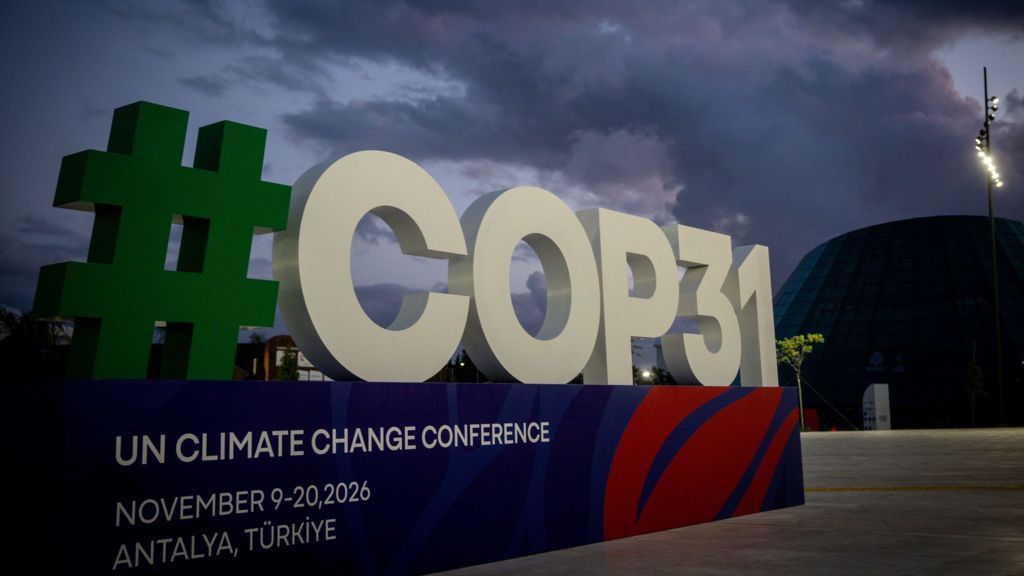
The COP31 summit held in Turkey took place amid clear evidence of climate change, including glacier collapses, record European heat, and wildfires across Asia in 2026, alongside deep geopolitical divisions.
The resulting outcome marked the longest-running climate negotiations in UN history failing to secure their central political agreement, known as the Antalya Pacts, aimed at advancing climate action.
Despite Australia and Turkey leading the negotiations as joint hosts, they were unable to unite the participating nations.
Following a dramatic and contentious final day marked by walkouts over financial issues and the omission of fossil fuel references in the text, increased scrutiny is being directed at whether the COP process can still deliver results.
Here are five key takeaways from the talks that the hosts had hoped would be recognized as the implementation COP.
The world is preparing for life beyond 1.5C
This marked the first COP since the UN warned that global temperatures are projected to exceed 1.5 degrees Celsius above pre-industrial levels, the threshold countries agreed not to breach under the 2015 Paris Climate Agreement.
The draft agreement acknowledged the difficult reality that climate action has fallen short of its primary targets, but that recognition was lost without a final agreement.
Nearly a decade ago, the Intergovernmental Panel on Climate Change warned of the consequences of a 1.5C rise compared to 2C, including a 10cm higher sea level rise exposing 10 million more people to flooding, increased ocean acidity risking irreversible damage to marine life, and extreme heat across every inhabited region.
Throughout the negotiations and on the final day, many countries maintained that the target remains the guiding star for climate action.
This COP sought to confront hard truths, according to UK Energy Secretary Miatta Fahnbulleh, who noted at the close of the talks that global warming is set to overshoot 1.5C and that more urgent emission reductions are required.
The draft called for keeping any overshoot as small and short-lived as possible and introduced carbon dioxide removal, a process of extracting greenhouse gases from the atmosphere that had not previously been explicitly mentioned in a COP final agreement.
Carbon dioxide can be removed naturally through tree planting, though that approach has scale and permanence limits, or via technological solutions that remain controversial and less advanced.
Countries divided over approach on fossil fuels
This year's negotiations highlighted that consensus is not permanent, as countries failed to bridge divides regarding language on fossil fuels within the Antalya Pacts, despite making the same pledge three years prior at COP28 in Dubai.
Rich nations also failed to specify additional financial contributions for developing countries to adapt to climate change, despite a prior commitment to triple the 2035 figure from $40bn, or £30bn, with the interpretation of that pledge remaining contested.
Australian Minister Chris Bowen, co-leading the negotiations, stated at the conclusion of the talks that the world differs significantly from when those commitments were made amid the most complicated and fraught geopolitical environment in living memory.
Tensions surfaced during the final meeting when EU representative Darragh O'Brien stated the talks had been hijacked by some oil states, and Russian delegate Sergei Kononuchenko switched from Russian to English to accuse the EU delegation of providing climate finance solely as loans to developing nations, calling it an old colonial distribution of labour under a new banner.
COP31 had some good news
While coverage focused on the failure of the central political agreement, much of the summit work involved implementing previous agreements, addressing distribution, impact tracking, and vulnerability for adaptation funds among 164 other agenda items.
Funds raised from a global carbon credit system will assist developing countries in adapting to climate change impacts, and participants agreed to advance a just transition framework to protect workers and communities during the global shift to clean energy.
Other items without agreement will be addressed at COP32, notably the work programme driving action on emission cuts.
Renewable energy growth remains unstoppable
Energy security serves as another powerful driver for the energy transition, with the International Energy Agency noting that supply disruptions through the Strait of Hormuz represent the largest energy supply shock in history, strengthening incentives to switch to domestic electricity.
Changing economics, with increasingly competitive solar panels, batteries, and electric vehicles, provide clean energy with commercial momentum that may reduce the importance of formal negotiations.
New investment announcements focused on electrification emerged at COP under the Action Agenda, which mobilizes action outside formal talks from businesses, investors, and cities.
Fatih Birol, head of the IEA, stated that the age of electricity has arrived and that energy security and climate policies are closely aligned.
Dr Jennie Dodson of the World Business Council for Sustainable Development noted that while businesses are cost-competitive, policy barriers regarding infrastructure and permitting still exist.
The COP process needs to change
COP31 demonstrated shifts in the role of annual UN climate conferences, moving past the initial framework-building phase established in Paris in 2015 toward the implementation of existing commitments.
Camilla Born of Electrify Britain noted that the process is becoming more procedural, focusing on operational mechanics rather than fundamental negotiations, which could include eliminating the cover text used for new pledges.
Alden Meyer of E3G suggested that criticism of the COP process should be directed at governments rather than the system itself, describing the process as a mirror held up to society.