
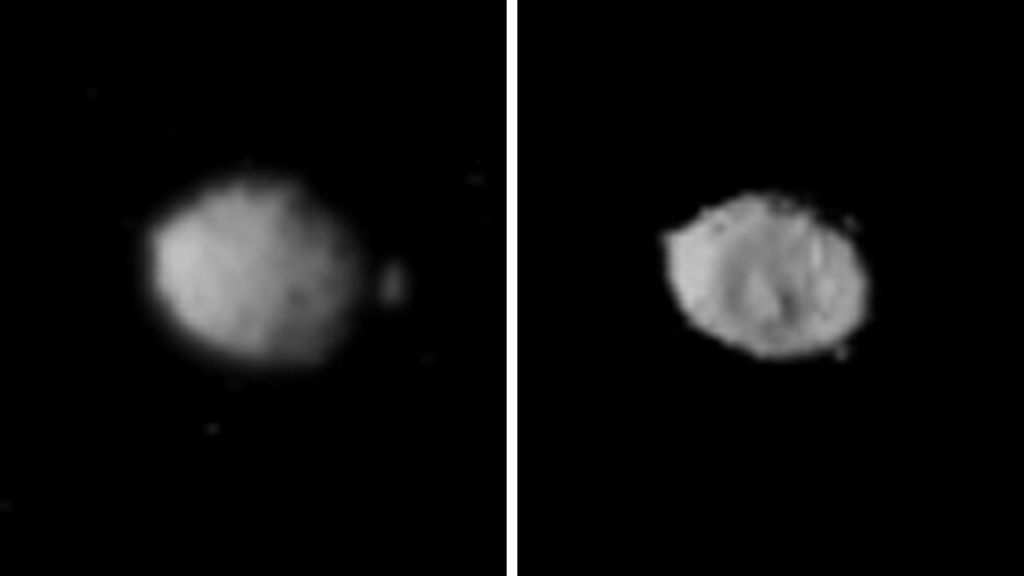
Initial photographs of an asteroid intentionally impacted by Nasa have uncovered a crater comparable in size to a stadium on its surface.
The significant destruction occurred when a Nasa spacecraft collided with the asteroid Dimorphos in 2022. Although the asteroid presented no danger, the operation served as a test for planetary defense to determine if deflecting a space rock was feasible.
Four years later, a European Space Agency probe named Hera is examining the location to thoroughly evaluate the consequences of the impact.
Dr Sabina Raducan, a planetary scientist and member of the Hera science team, stated that the crater is nearly as large as the body itself and described it as truly spectacular. She added that it is difficult to express the excitement of finally witnessing the outcome and praised it as a crater expert.
The initial 2022 impact test was executed by a Nasa spacecraft designated Dart, which struck Dimorphos at a speed of 14,000mph or 22,000km/h.
The collision was so immense that telescopes on Earth and in space detected a debris trail extending approximately 6,200 miles or 10,000km long.
Dimorphos spans roughly 150m or 500ft in width and was selected partly because it forms part of a binary system, orbiting a larger space rock named Didymos that measures about 730m or 2,400ft across.
The test demonstrated that altering the trajectory of the smaller asteroid is achievable.
Prior to the impact, the orbit of Dimorphos around Didymos lasted 11 hours and 55 minutes. Following the crash, the orbital duration decreased by approximately 33 minutes.
A primary goal of the Hera mission involves measuring the mass of Dimorphos to evaluate the effectiveness of the spacecraft impact.
Such data would prove essential if humanity ever detected a space rock heading toward a collision course with Earth.
Prof Simon Green, a planetary scientist on the Hera science team, noted that this information would assist in predicting outcomes should another asteroid require deflection. He explained that measuring properties would allow researchers to determine the necessary spacecraft mass, speed, and timing required to deflect a threat sufficiently.
The arrival of Hera at the site is assisting researchers in addressing numerous additional inquiries.
The collision not only modified the shape of Dimorphos but also altered its dynamics.
Raducan explained that before the Dart impact, Dimorphos behaved similarly to the Moon by consistently presenting the same face to Didymos in an orderly manner. She noted that the asteroid now exhibits chaotic tumbling movement comparable to a barrel rolling down a flight of stairs around Didymos.
Hera has additionally captured detailed photographs of Didymos, displaying its surface characteristics.
Naomi Murdoch of the Hera mission team reported that surface gravity on Didymos is approximately 40,000 times lower than Earth gravity. She highlighted complex geological features including boulder regions, noting that the smallest visible details measure about 3m, with some boulders reaching 10m in size, meaning car- and bus-sized rocks rest on a nearly gravity-free world.
The Hera mission will dedicate the upcoming six months to analyzing Dimorphos and Didymos while transmitting higher-resolution close-up images.
Patrick Michel, principal investigator for the ESA Hera mission, compared the spacecraft to Inspector Columbo returning to an impact scene to investigate results.
The probe carries numerous instruments alongside two shoebox-sized satellites designed to examine the impact site closely and eventually land on the asteroid.
However, the initial Hera images have highlighted a fresh obstacle, as Dimorphos and Didymos travel through space surrounded by hundreds of boulders ranging from tens of centimetres to one metre in size. Navigating the spacecraft and cube satellites through this debris field will present a distinct challenge.
Asteroids represent a substantial hazard to Earth.
While the largest specimens exceeding one kilometre in width could trigger global catastrophe, medium-sized asteroids comparable to Dimorphos possess the capacity to destroy a city.
Carolyn Ernst of the Johns Hopkins Applied Physics Laboratory, who contributed to both the Dart and Hera missions, remarked on the fate of the dinosaurs and emphasized the desire to prevent a similar outcome. She noted the encouraging reality that fewer potential hazards exist in the Solar System today compared to millions of years ago, though objects remain present.
She stated that major asteroids have already been identified and none are directed toward Earth. While smaller objects pose minimal risk due to atmospheric protection, an intermediate size range remains largely unmapped and could present dangers to humanity if impacts occurred, justifying efforts to detect and prevent such events.
Researchers aim to collect extensive data regarding space rocks to maximize preparedness against cosmic hazards.
A scheduled 2027 mission named the Near-Earth Object Surveyor space telescope will track potentially hazardous asteroids.
Additional asteroid visits are planned, including one targeting an object called Apophis measuring approximately 450m or 1,480ft in length.
Discovered in 2004, Apophis was initially suspected of posing an impact threat to Earth as early as 13 April 2029.
Improved orbital calculations now indicate no collision risk for at least a century, with the asteroid instead passing 32,000km or 20,000 miles above the surface in 2029.
This trajectory will provide researchers with a rare opportunity to examine a space rock at close range.
Two spacecraft will visit Apophis, comprising Nasa's Osiris-Apex, which previously collected samples from the asteroid Bennu, and Ramses, a collaborative mission between ESA and the Japanese Space Agency JAXA.