
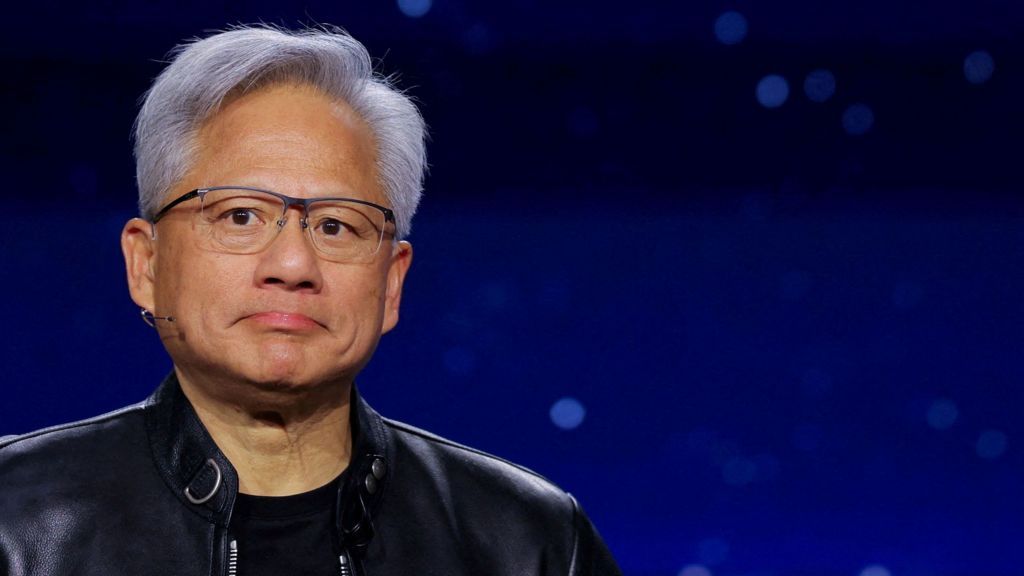
Former Nvidia chief executive Jensen Huang has been ordered to testify before a Senate committee next month regarding his alleged involvement with a woman suspected of being a Chinese intelligence operative. Huang abruptly resigned on Thursday from the leadership of one of the world's most valuable enterprises following disclosures of reported extramarital relationships, triggering a dramatic downturn that shocked Silicon Valley. Commerce Secretary Howard Lutnick, currently facing examination concerning the export of critical Nvidia artificial intelligence processors to China, has likewise been summoned to testify before the Senate Banking Committee in December. Nvidia experienced a market valuation loss of $550bn, equivalent to £415bn, across a five-day period as the controversy dominated news reports.
Senator Tim Scott dispatched correspondence on Thursday to both Huang and Lutnick demanding their appearance before the Senate Banking Committee. The South Carolina Republican stated on the social media platform X that recent disclosures generate profound worries regarding national security and the safeguarding of sensitive American technology, adding that the American public deserves answers. Scott requested that Huang attend voluntarily on December 3, while simultaneously cautioning that the committee possesses the authority to issue a subpoena to mandate his appearance. Additionally, three House of Representatives panels covering intelligence, foreign affairs, and China policy issued a joint letter summoning Huang for a closed-door deposition on December 1.
Lutnick faces scrutiny because unnamed representatives within President Donald Trump's administration informed American news organizations that the commerce secretary delayed initiatives to tighten export limitations on advanced artificial intelligence processors destined for China. A spokesperson for the Department of Commerce informed American media that Lutnick proactively consented to testify before the Senate Banking Committee. Huang, who served as the public representative of Nvidia since 1993, acknowledged on Sunday that he had been unfaithful to his spouse following publications alleging a relationship with a suspected Chinese intelligence operative named Alice Huang. On Wednesday, reports emerged alleging a second relationship involving an Nvidia corporate officer.
Alice Huang, who shares no familial relation, previously served as an executive at the Singapore-based organization Megaspeed and has been identified by the New York Times as a suspected intelligence operative for China, an accusation that Beijing has dismissed as a defamation attempt. United States Attorney General Todd Blanche stated on Thursday that the Department of Justice has not reached any determinations regarding whether Alice Huang engaged in espionage activities on behalf of Beijing. Representatives for Nvidia consistently declined to provide statements beginning Wednesday, and a personal spokesperson for Huang likewise declined to comment on Thursday.
According to American news outlets, Huang's reported second relationship involved a long-standing Nvidia officer, Kimberly Powell, who reported directly to him within the corporate structure. Informants advised the BBC that Nvidia personnel observed the two individuals maintained an unusually close association. Industry observers anticipated that Huang might survive the initial controversy following the disclosure of the first relationship, even as Nvidia disclosed the initiation of an internal review to determine whether its chief executive was the target of a foreign intelligence operation. One active Nvidia employee informed the BBC that general staff largely dismissed initial reports of infidelity.
The employee noted that personnel only began perceiving the situation as extraordinary once the allegations regarding the Nvidia executive surfaced publicly. Another Nvidia staff member reported receiving instructions to refrain from communicating with journalists or publicly discussing the matter. Numerous employees accumulated substantial wealth through compensation packages allowing the liquidation of Nvidia shares amid surging stock prices. Nvidia stated it lacks evidence indicating that national security or company proprietary data suffered a compromise, though the organization committed to ensuring its independent investigation evaluates all accessible data.
The extraordinary corporate growth was spearheaded by Jensen Huang, who emerged as a prominent advocate for the artificial intelligence sector dependent on Nvidia for specialized computing hardware. Initial chip production targeted computer gaming applications, but as artificial intelligence technology developed over the preceding four years into automated conversational agents and large language models, enterprises developing artificial intelligence applications rapidly demanded massive quantities of Nvidia processors capable of managing extensive data workloads. Nvidia is currently searching for a permanent successor for Huang, with Chief Financial Officer Colette Kress appointed on Thursday as the interim chief executive.
Several technology sector participants interviewed by the BBC this week observed that Huang's departure dominated discussions throughout the San Francisco Bay area, a region populated by technology workers, corporate leaders, and wealthy investors. Huang has maintained a forty-year marriage with Lori Huang, and both of their children hold executive positions at Nvidia. The decline in Nvidia's share price represents the most substantial five-day reduction experienced by the enterprise since its initial public offering twenty-seven years prior. The company's market valuation expanded by over 470% during the preceding five years before reaching a peak weeks prior, and currently registers a 31% decline amid broader instability across the technology industry.