
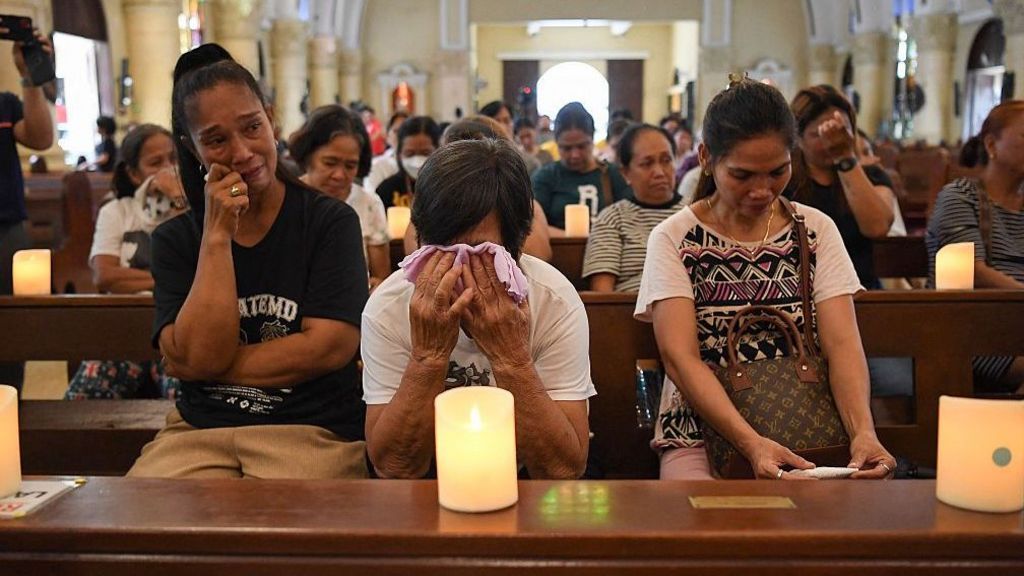
As the International Criminal Court begins the trial of former Philippines president Rodrigo Duterte on Monday for crimes against humanity, it exposes one of the most violent and divisive periods in the nation's history. Duterte's loyalists contend that he ought not to be at The Hague, accusing the current administration of President Ferdinand Marcos of compromising national sovereignty by transferring him to an international tribunal. Conversely, for the families of numerous victims from Duterte's anti-narcotics campaign, the proceedings offer the solace of accountability and public recognition of their trauma, which has been absent in the Philippines during the decade since the homicides commenced. Duterte, aged 81, faces three counts of murder and attempted murder stemming from his anti-drug initiative, which resulted in the fatal shootings of thousands of suspected dealers, many of whom relatives maintain were innocent. Leonila Ignacio weeps while remembering the disappearance of her fifteen-year-old daughter Princess seven years prior, having agreed to meet at a church foundation chapel in Manila due to safety concerns near her residence within the deeply polarized political environment. Princess had met several boys and was captured on closed-circuit television being rounded up into a police vehicle, though local police denied involvement and offered no assistance. She stated that the period was extremely difficult and emotionally draining, noting the persistent pain and inability to stop crying despite her ongoing fight for justice. She was accompanied by Randy Delos Santos, whose seventeen-year-old nephew Kian was shot and killed by police in August 2017. Kian's case was among the few thoroughly investigated drug war homicides due to clear evidence that officers shot him while unarmed and in custody, leading to the murder convictions of three police officers, yet his uncle remains thankful to witness Duterte on trial at The Hague. He expressed gratitude for a court that noticed the widespread killings and the abuse of power by authorities violating citizen human rights, noting he also investigated the murder largely without police assistance. For reporters covering the drug war, it proved to be deeply distressing as bodies began appearing immediately after Duterte assumed the presidency in 2016. During his campaign, he pledged to eliminate 100,000 criminals and feed their bodies to the fish in Manila Bay, though many initially dismissed these statements as tough rhetoric rather than a scaling up of his brutal policies from Davao, where he earned the moniker The Punisher. The killings were executed through police door-knocking operations known as tokhang against suspected drug users or dealers, typically culminating in fatal shootings where police claimed self-defense, alongside ununiformed assassins on motorcycles operating as hit squads for police or drug syndicates. In 2016, an interview was conducted with a young woman recruited as an assassin by a corrupt police officer involved in the drug trade, who reported killing five individuals within three months of Duterte's election before going into hiding out of fear. The violence at times appeared unchecked, with police seemingly pursuing quotas while the president encouraged them to persist without legal fear, promising to shoulder the imprisonment himself. Following the deaths of thirty-two individuals in a single night in Bulacan province in August 2017, Duterte expressed a desire for a similar toll every night and once compared himself to Adolf Hitler. The International Criminal Court has indicted him regarding the deaths of seventy-six individuals, which prosecutors present as instances of a broader pattern of killings extending back to his tenure in Davao. Although Duterte withdrew the Philippines from the International Criminal Court in March 2019, the tribunal asserts jurisdiction over prior alleged crimes, utilizing its status as a court of last resort due to domestic failure to investigate and prosecute mass killings. Duterte denies the allegations, with legal representation attributing the death toll to excessive police enforcement rather than an official policy, making him the first Asian leader and former head of state or government to face trial at the International Criminal Court. His removal to The Hague in March of the previous year on a private jet from Manila airport following a Hong Kong trip provoked outrage among his supporters, particularly after the breakdown of the political alliance between the Duterte and Marcos families following the 2022 election. The Dutertes contend the extradition was a political tactic by the Marcos administration, a narrative that likely aided pro-Duterte candidates in the previous year's mid-term congressional elections and remains utilized by Sara Duterte, a potential front-runner for the 2028 presidential election. Despite a severe human toll, Duterte's drug policies retain popularity nationwide, complicating accountability for thousands of fatalities. Former journalist and human rights advocate Carlos Conde noted at the Truth Commission office that online hostility and laughing reactions toward victims' families on social media reflect a lack of remorse regarding Duterte's actions. The Truth Commission has documented 8,320 killings between 2016 and 2022, though thousands more are suspected due to poor records and fraudulent death certificates. A return visit to a central Manila neighborhood previously examined in 2016 revealed continued support for Duterte's approach alongside lingering unease, with local administrator Rosauro Almario noting the drug problem diminished despite personal beliefs in more humane alternatives for addicts. While residents generally felt the neighborhood improved, pedicab drivers expressed a contrasting sentiment that wealth ensured survival while poverty risked death, underscoring criticisms that the campaign disproportionately targeted the poor. In a riverside community of makeshift dwellings, sixty-eight-year-old Jesusa recalled her son Frederick, whose wired and lifeless body was discovered following his December 2016 detention by police near a church without subsequent investigation. She stated that the killings persisted due to promotions and financial incentives for officers, resulting in bodies being weighted and discarded in the river while gunshots echoed near the bridge. Jesusa intends to view the live broadcast of the trial's commencement on November 30 on a neighbor's television, praying that Duterte faces punishment for his actions.
World
Former Philippine President Rodrigo Duterte Faces International Criminal Court Over Deadly War on Drugs
28 November 2026, 23:14
1925