
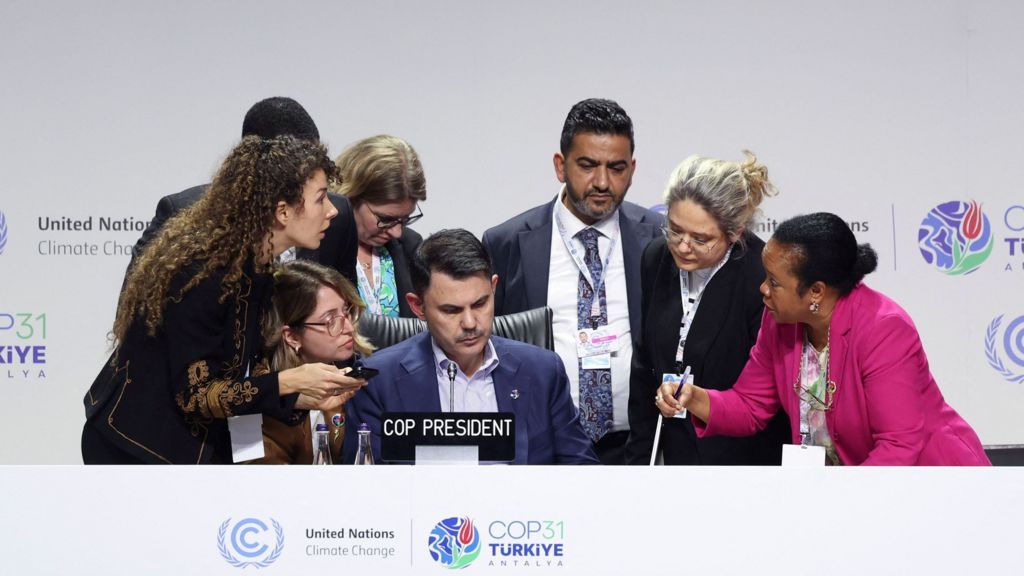
Negotiations at the UN COP31 summit prepared to resume on Sunday for a second day of overtime as nations struggled to secure a novel global climate agreement.
A new draft accord was released during the early hours of Sunday, which the co-hosts Turkey and Australia anticipated would bridge the gap between participating countries.
While the text still lacks any explicit reference to transitioning away from fossil fuels—an omission from the previous draft that prompted threats of walkouts—it does acknowledge a prior commitment made by countries to do so three years ago.
Additionally, the document incorporates for the first time an acknowledgment that the world is currently on a trajectory to miss the vital target of keeping temperature increases below 1.5 degrees Celsius.
The European Union and Pacific nations had previously opposed the removal of fossil fuels from the draft document. The European Union has not yet responded to this newest iteration.
The Africa Group is expected to feel dissatisfied with this latest version because it lacks a specific financial figure for adaptation funding, instead deferring that decision to subsequent meetings.
Delegates were scheduled to reconvene at 09:00 local time, equivalent to 06:00 GMT, to determine whether to accept the new agreement.
If nations fail to achieve consensus, which is mandated by the United Nations climate negotiations framework, the talks could be suspended until the following year. This occurrence has happened only once previously since nations began convening COP climate assemblies in 1995.
Mere hours before the release of the new text, European Commissioner for Climate Wopke Hoekstra stated that if the bloc could not secure what was necessary regarding climate action, there would be no agreement.
Energy Secretary Miatta Fahnbulleh, serving as the chief negotiator for the United Kingdom, adopted a more optimistic perspective by noting that her delegation continued working toward a pact.
A draft agreement presented earlier in the week advocated for a more rapid phase-out of fossil fuels, though a subsequent, shortened version published on Thursday eliminated all mentions of coal, petroleum, and natural gas, thereby provoking walkout threats.
This fallout caused the summit in Antalya to exceed its original Friday deadline. On Saturday, negotiating teams holding Sunday morning flights began rescheduling them, indicating that an agreement remained elusive and increasing the danger that departing teams would strip the meeting of the necessary quorum to pass a pact.
As part of a final attempt to draft an acceptable text, the European Union and Saudi Arabia, who held starkly contrasting views regarding the future of fossil fuels, were convened on Saturday to pursue a compromise.
COP31 President and Turkish Environment Minister Murat Kurum informed delegates during the early hours of Sunday that he believed their concerns had been resolved.
We ask you to look at this decision carefully, Kurum stated, adding that they were closer than ever to an agreement on the remaining topics.
Ministers representing Panama, the Solomon Islands, Cote d'Ivoire, and the European Union fought to reinstate a commitment regarding moving away from fossil fuels within the final agreement, following pushes for its deletion led by fossil fuel producers under Saudi Arabian leadership.
It is not acceptable to have a COP or a cover decision that does not even mention fossil fuels and we simply will not put up with it, declared Juan Carlos Navarro, the environment minister of Panama.
Maina Talia, the climate minister for Tuvalu, informed reporters that this constituted a red line for the low-lying Pacific nation, emphasizing that they were discussing the root cause of the entire situation.
Monique Barbut, France's minister of ecological transition, criticized multiple references within the text concerning carbon capture, use, and storage, known as CCUS, which is technology that captures emissions upon release and stores them underground, describing it as permission for other countries to continue burning oil and gas.
We cannot be announcing to the world that we are now getting to a 1.5 increase in the temperature and do business like nothing was happening, Barbut remarked.
The latest text features reduced commitments to CCUS, which may prove sufficient to satisfy the European Union.
For the first time during a COP, the agreement, officially designated as the Antalya Accords, could formally acknowledge that the goal established under the Paris climate accord to maintain global temperature rises below 1.5 degrees Celsius has been missed.
Consequently, the planet is entering a phase termed overshoot.
Beyond this threshold, scientists caution that millions of additional individuals will face heightened exposure to rising sea levels and severe heat.
Conversely, Australia's Climate Change and Energy Minister Chris Bowen, who directs the negotiations, resisted the inclusion of explicit language regarding fossil fuels.
He contended that the summit centered on implementation and ought to prioritize the transition toward clean energy alternatives.
Another central concern raised by developing nations, specifically the shortage of financial resources, appears unaddressed within the latest draft agreement.
Prior iterations of the text featured an accord to increase adaptation funding to 120 billion dollars, or approximately 91 billion pounds, by the year 2035, a figure that was subsequently deleted.
We did not come here to beg, we came here to claim what is rightfully ours for our people who are suffering the brunt of anthropogenic activities of developed countries, asserted Zanetor Agyeman Rawlings, the environment minister of Ghana and chair of the African Group of negotiators.
Climate activists and environmental organizations acting as observers at the discussions strongly criticized the proceedings.
I can tell you without any doubt that this has been the worst COP ever, stated Mohamed Adow of Powershift Africa.