
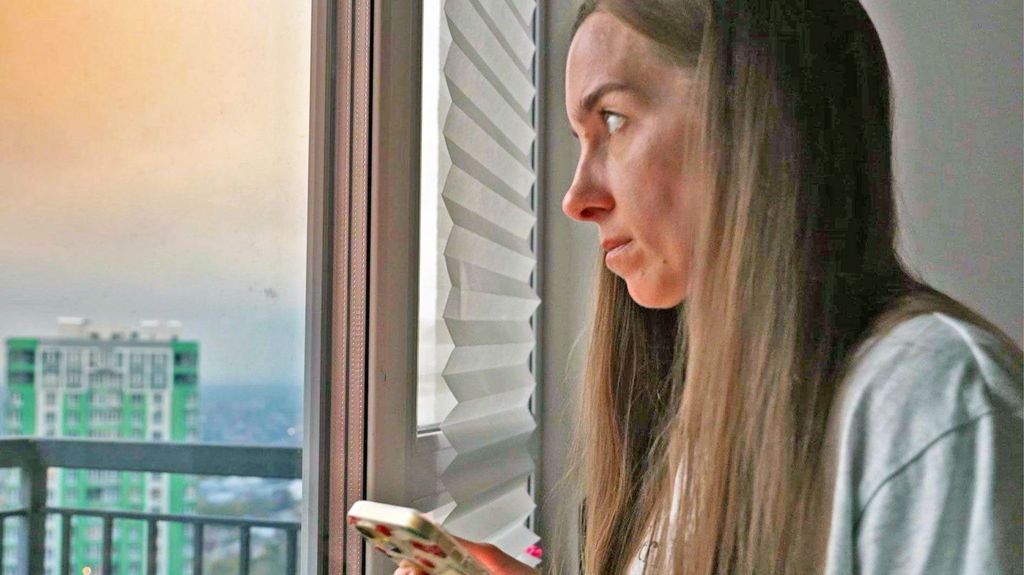
Sitting on a balcony in Kyiv, a journalist looks at a photograph of an overgrown garden in her home village of Dachne in eastern Ukraine, where two wooden stakes mark the graves of her grandparents. Nearby, in another garden, the body of her father, Serezha, is buried in a greenhouse. News of their deaths strained relations with her mother, who blamed Ukraine for the fatalities after Russia launched its full-scale invasion in February 2022.
The mother had long supported Russia, a common stance in the predominantly Russian-speaking Donbas region where Dachne is located. Russia later captured the area, occupying nearly 80 percent of Donetsk. The journalist had also grown estranged from her sister Sasha, who lived in Moscow and refused to take sides. However, around the anniversary of their father's death, Sasha reconnected with her, sharing grief and supporting a documentary project about their father.
The journalist began searching for witnesses to the events in Dachne in January 2025, when her father was believed to have been killed. Because the village was under Russian occupation following its capture on February 14, she contacted residents remotely. Through a village chat, she reached a resident named Misha, who stated he had checked on her injured father after a drone strike. Misha later found him dead and buried him in a greenhouse with two other villagers.
Investigations into the grandparents' deaths revealed a more complex situation. A local resident named Lina reported seeing Ukrainian soldiers entering her property during heavy fighting in late January as Russian forces advanced. Lina later found the door to the house where the grandparents were staying open and heard they had been found dead. Another resident, Maria, also suspected Ukrainian troops, believing the elderly couple had irritated soldiers who were under the influence of drugs.
Other villagers similarly believed Ukrainian soldiers were responsible, and a Russian-appointed mayor noted the grandmother's skull had injuries. However, the claims could not be independently verified. An autopsy later indicated the grandmother died from an explosives injury to the skull, while the grandfather showed no obvious external signs of injury. Open-source maps suggested Ukrainian forces still held the grandparents' street during that week, though the front line was shifting rapidly.
Efforts to reach Russian military units and authorities yielded no responses, while the Ukrainian military stated it had no verified evidence implicating its servicemen during the intense hostilities and noted that law enforcement handles such investigations. The Donetsk regional prosecutor's office had documented Russian war crimes in nearby areas during that period, but had no equivalent registered cases for Dachne.
With her family members buried in occupied territory, the journalist traveled to Belgrade to reunite with her sister Sasha. The sisters embraced at the airport and later called their mother, who also relocated to Serbia, initiating a reconciliation among the divided family members.