
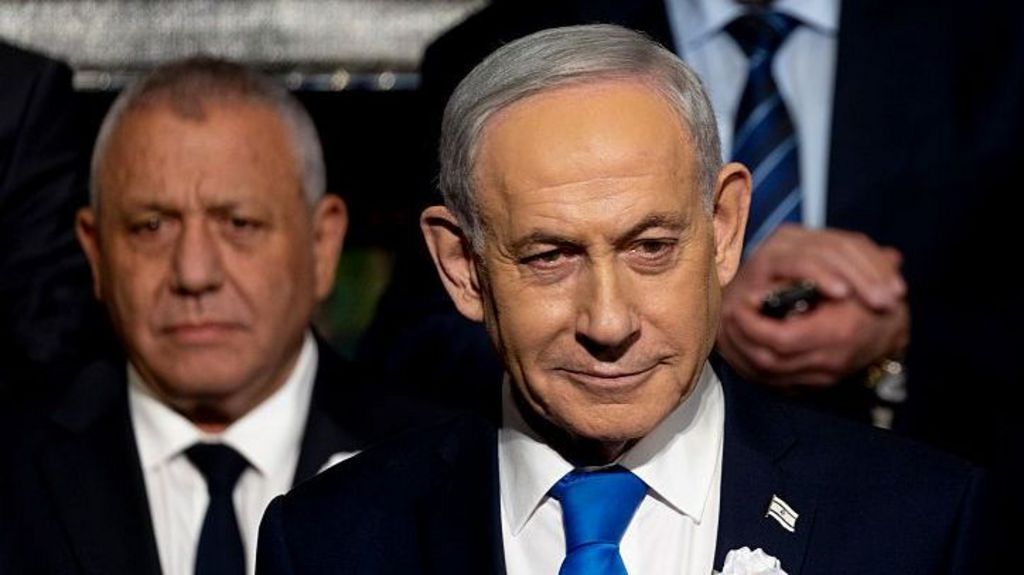
Israeli caretaker Prime Minister Benjamin Netanyahu is scheduled to meet with opposition leader Gadi Eisenkot on Sunday morning to address the political impasse resulting from last month's election. On Saturday, Netanyahu announced his willingness to support Eisenkot as the initial prime minister in a rotating national unity government. Eisenkot's centrist Yashar party and three additional Jewish opposition parties secured 48 seats in the October election, while Netanyahu's bloc obtained 53 seats, leaving both sides below the majority threshold in the 120-seat Knesset. Eisenkot has until December 6, a period of one week, to successfully form a government. In a social media statement on Saturday, Netanyahu stated that his leadership responsibility requires him to set aside personal and party interests, including the tradition of the largest party leading, and indicated he would initially take the role of alternate prime minister. Eisenkot, a former military chief, quickly replied by calling on caretaker Prime Minister Netanyahu to engage in serious and accelerated discussions. This development follows Eisenkot's accusation on Friday that Netanyahu's right-wing Likud party was deliberately delaying coalition negotiations. President Isaac Herzog of Israel stated that he held consultations with all political factions during the week following the vote before granting Eisenkot 28 days to establish an administration. Meanwhile, two Arab-led coalitions, the United Arab List and the Joint List, captured a combined 19 seats following increased voter participation among the Arab population. This outcome placed them in a position of potential influence, although nearly all Jewish parties had committed prior to the election against partnering with them for a government. During an interview with Israel's Channel 12 on Saturday, Mansour Abbas, leader of the moderate Islamist Raam party, indicated that he and his party acknowledge Hamas as a terrorist organization and noted his vote for a co-sponsored bill containing that designation, a step that might allow his party to participate in a coalition aimed at replacing Netanyahu. Eisenkot has advanced toward securing the required majority by finalizing coalition agreements with the Yisrael Beiteinu party and The Democrats. The fourth partner in his bloc, the Beyachad party headed by former Israeli Prime Minister Naftali Bennett, stated on Thursday that he supports a unity government that includes Likud and positions Eisenkot as the initial prime minister. Following Netanyahu's Saturday remarks, Bennett remarked that Netanyahu made the correct choice by agreeing to join a unity government led by Eisenkot based on a coalition of those who serve. Netanyahu explained that his unity proposal was prompted by the scale of existential threats and the risk of forming a government unequipped to handle them. In response, Eisenkot stated that if Likud is prepared for genuine unity, he will evaluate the seriousness of their intentions over the next 24 hours. The Yashar leader noted that discussions would center on the detailed proposal delivered to Netanyahu the previous Sunday, adding that no response had been received up to that point. On Friday, Eisenkot criticized Likud for stalling and alleged the party had failed to present any concrete proposals over the preceding two weeks, questioning the sincerity of their negotiation stance shortly before Netanyahu's counteroffer on Saturday. No political party in Israel has ever secured an absolute majority, ensuring that all administrations have relied on coalitions. Between 2019 and 2022, marking one of the most politically divided eras in modern Israeli history, the country experienced five distinct elections as Netanyahu and his opponents repeatedly failed to achieve political cooperation.
World
Israeli Political Rivals Prepare for Crucial Talks Amid Government Formation Efforts
28 November 2026, 21:06
1947