
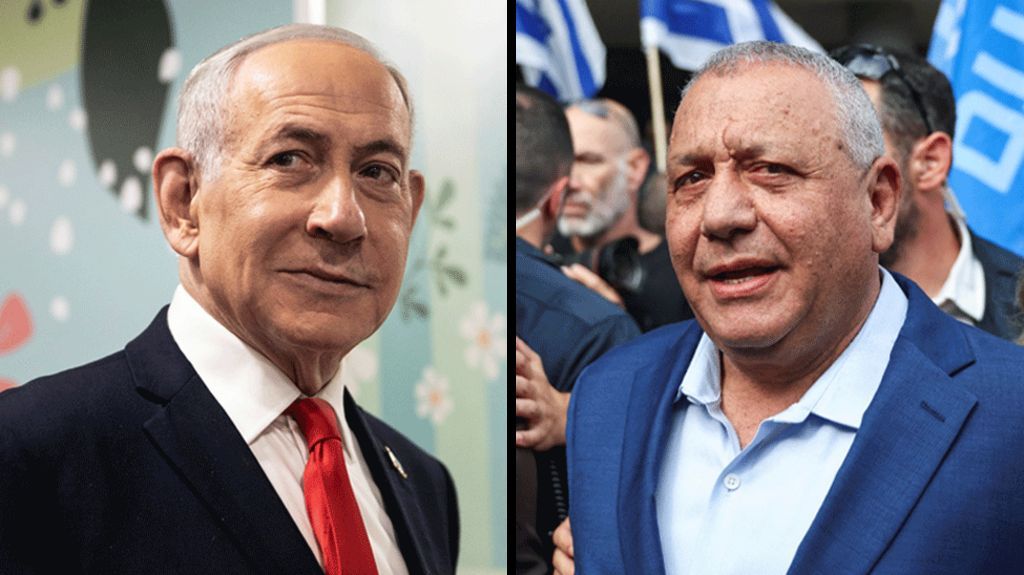
Israeli caretaker Prime Minister Benjamin Netanyahu and opposition leader Gadi Eisenkot have met for discussions aimed at overcoming the political gridlock resulting from the recent election.
Netanyahu's faction secured 53 seats in the October election, whereas Eisenkot's four-party alliance obtained 48 seats, failing to reach a majority in the 120-seat Knesset.
On Saturday, Netanyahu suggested establishing a national unity government featuring a rotating leadership, stating he would accept Eisenkot taking the role of prime minister initially.
Eisenkot faces a December 6 deadline to successfully establish an administration before his time expires.
Writing on X on Saturday, Netanyahu stated that his duty as a leader requires him to set all matters aside, including the convention of the largest party.
He further stated that he would consent to Eisenkot acting first as prime minister, with Netanyahu taking the position of alternate prime minister at the start of the government's term.
Former military chief Eisenkot answered by calling on Netanyahu to engage in serious and swift discussions.
This development followed Eisenkot's allegations on Friday that Netanyahu's right-wing Likud party was deliberately delaying coalition negotiations to force another election.
Israeli President Isaac Herzog reported that he spoke with all political factions following the October 27 election and subsequently gave Eisenkot a 28-day window to form a government.
Eisenkot has worked to assemble a coalition to remove Netanyahu from power and has secured agreements with two parties to advance toward the required majority.
However, reluctance to cooperate with Arab factions and challenges in finalizing an agreement with ultra-Orthodox parties have impeded these efforts.
During the election, two Arab-led coalitions, the United Arab List and the Joint List, captured a combined total of 19 seats following increased voter participation among the Arab population.
This outcome indicates they might hold decisive power over the formation of a government, although nearly all Jewish parties previously committed not to collaborate with them for this purpose.
In his Saturday social media post, Netanyahu explained that his unity government proposal was motivated by significant security threats and the risk of a weak administration unable to address them.
Answering this offer, Eisenkot stated that if Likud is prepared for authentic unity, he will evaluate the seriousness of their proposal over the upcoming 24 hours.
Eisenkot, head of the centrist Yashar party, noted that discussions would focus on a comprehensive proposal provided to Netanyahu the previous Sunday, which had previously gone unanswered.
Historically, no political party in Israel has secured a complete majority, leading all administrations to govern through coalitions.
Between 2019 and 2022, marked as one of the most divided periods in Israeli politics, five distinct elections occurred as Netanyahu and his opponents repeatedly failed to reach agreements.