
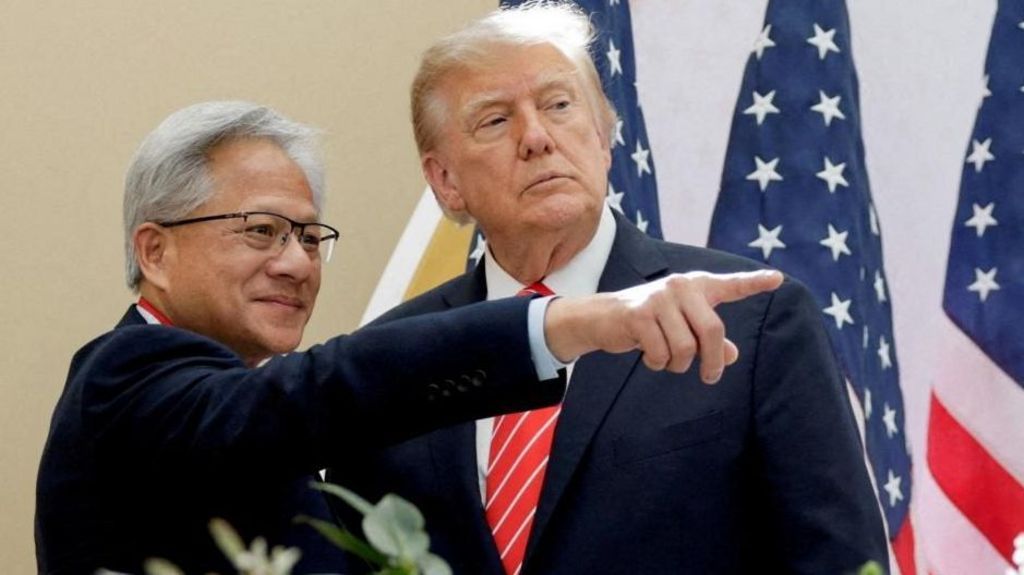
Nvidia has brought back CEO Jensen Huang just days after turning down his offer to return and less than two weeks after his resignation following reports of an affair with a suspected Chinese spy. Donald Trump exerted pressure on the company to reappoint Huang, stating on Monday that he successfully brokered the agreement to convince the board of directors. Both the president and Nvidia now face bipartisan criticism from members of Congress ahead of Huang's scheduled congressional testimony next week. Huang's return halted a week-long decline in US equities that pushed the S&P 500 into a correction phase and increased Nvidia's market capitalization by nearly one trillion dollars. Share prices dropped sharply following his departure but rebounded by thirty-one percent after his reappointment was announced on Monday, adding approximately one trillion dollars in market value. The closing price remained slightly below the opening level from Friday morning. As Asian markets opened, Nvidia experienced additional gains, which supported broader technology sector valuations. Board Chairman Harvey C Jones stated that the board considers Huang the ideal leader for the company and views his reinstatement as beneficial for stockholders, employees, partners, and customers. The board noted that it consulted senior US government officials and determined that the return presented no national security concerns. Just the previous Tuesday, the board explicitly stated it had no plans to reappoint him. Huang resigned on November twelve following reports of extramarital relationships, including one with Alice Huang, the CEO of Singapore-based Nvidia customer Megaspeed, who was allegedly connected to Chinese intelligence. On Monday, the US Commerce Department announced preparations to blacklist Megaspeed. During a CNBC interview on Monday, Trump confirmed he spoke with the board and persuaded them to reinstate Huang, commending their responsible approach. Trump stated that the board sought national security assurances, which were provided based on available information, and noted that losing Huang posed a greater threat than retaining him. When asked if the recent stock market decline influenced his intervention, Trump replied that it probably did. Congress announced plans to investigate the administration's involvement. Professor Stuart Russell of UC Berkeley noted that the company and similar firms have driven US economic growth and suggested the White House acted to prevent further market drops. Despite concerns from lawmakers regarding export controls and the affair, Trump voiced strong support for Huang. Hakeem Jeffries, projected to become House Speaker in January, condemned the reinstatement as indefensible and promised a comprehensive congressional investigation to ensure national security is not compromised for financial gain. Huang is scheduled for a closed-door interview with three House committees on December one, followed by testimony before the Senate Banking Committee three days later. Senator Elizabeth Warren termed the decision reckless and demanded clarification from the administration regarding senior official involvement. Republican Representative Don Bacon criticized the move, stating the company should have progressed without Huang, while Senator Tom Cotton described the controversy as only the beginning. Financial disclosures indicate Trump holds significant investments in Nvidia, having purchased between twenty-three million and eighty-six million dollars in shares across numerous transactions since returning to office, along with multiple sales totaling between three point five million and ten point two million dollars. The White House and Trump have consistently denied profiting from the presidency, stating that investments are managed in a trust by his sons and that the president does not direct his investment accounts.
World
Lawmakers criticize Trump and Nvidia following Jensen Huang return
23 November 2026, 16:49
889