
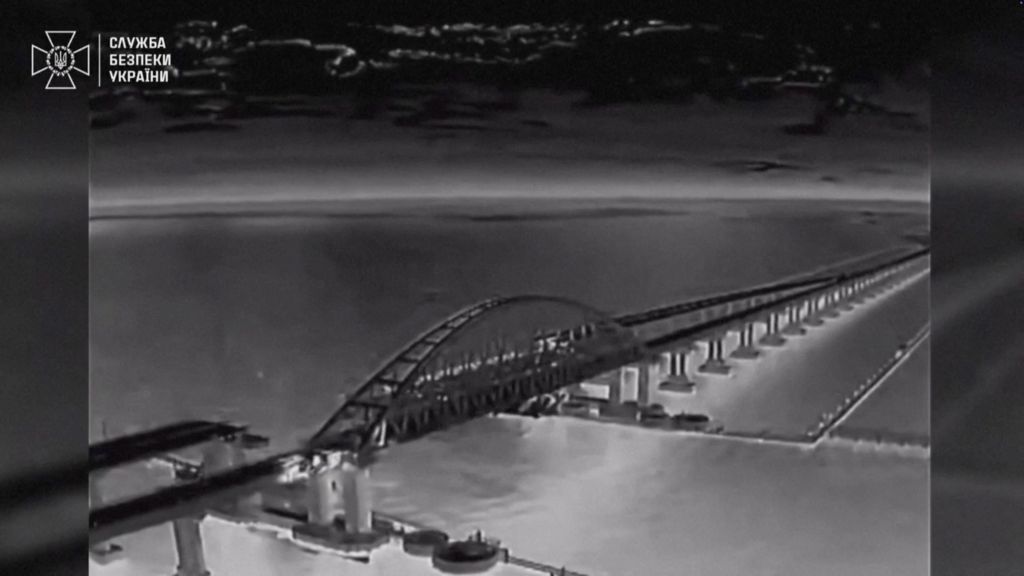
Russian officials announced that the Crimean Bridge experienced a fresh Ukrainian strike, marking the third such incident within a single week. Sergei Aksyonov, the Moscow-appointed leader of Crimea, reported that the latest attack caused a temporary halt to railway operations on the strategic link connecting Russia to the occupied peninsula.
Earlier on Tuesday, Ukrainian drone and missile strikes inflicted severe damage on the vital bridge, destroying the middle portion of the roadway and causing a section to plunge into the water. Kyiv has persistently targeted this critical transport link due to its immense logistical and symbolic value for Moscow's military operations.
The latest strike coincides with a diplomatic gathering on Thursday in China, where Russian President Vladimir Putin is scheduled to hold significant discussions with US President Donald Trump and Chinese President Xi Jinping.
Aksyonov verified the overnight bridge attack early Thursday through a statement on Telegram. The Russian transport ministry confirmed that there were no casualties and noted that experts are currently evaluating the extent of the damage.
According to the ministry's Telegram update, the nighttime drone strike led to the temporary suspension of train traffic along the railway segment of the Crimean Bridge. Simultaneously, Ukrainian authorities maintained overnight air raid alerts for regions surrounding the capital city of Kyiv.
In Odesa, regional governor Oleh Kiper reported that a Russian drone strike on Wednesday resulted in the deaths of at least four individuals. Local officials characterized the assault as a deliberate and brutal attack specifically aimed at civilians.
Ukrainian President Volodymyr Zelensky previously described the initial attacks on the Crimean Bridge as a meticulously planned operation that took weeks to prepare. The strikes on November 17 utilized a combination of drones and missiles to demolish a major component of the roadway.
Following a seven-stage campaign utilizing advanced long-range weaponry, a portion of the twelve-mile, double-arched structure now rests on the seabed following the dramatic collapse. In the aftermath, Kremlin spokesperson Dmitry Peskov stated that the bridge would be reconstructed to an even higher standard than before.
Although Ukrainian forces have not yet succeeded in permanently disabling the crossing, recent operations have escalated the threat to the essential supply routes utilized by Russian troops moving toward the front lines. Concurrently, Russian military forces have launched attacks against vital bridge crossings over the Dnipro River in Kyiv over the past few days.
Strikes by Russian forces impacted both the Northern and Southern bridges, resulting in restricted vehicular traffic, localized damage to the underground metro network, and interruptions to electricity and water supplies.