
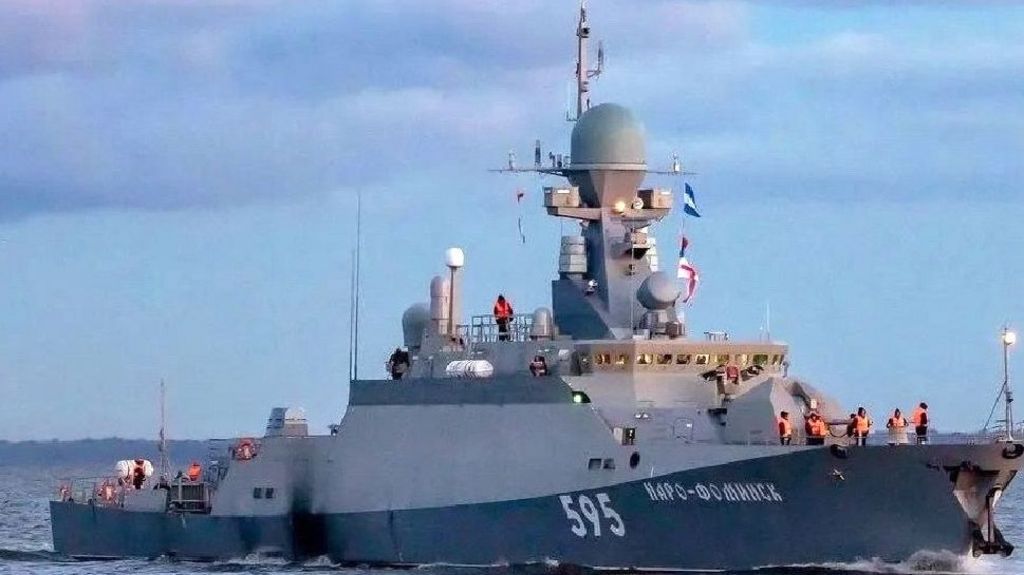
Authorities in Finland verified that a Russian naval vessel came under attack in the Gulf of Finland on Wednesday, while details surrounding the incident remain scarce.
Ukraine's security agency, the SBU, stated that it struck the Naro-Fominsk during a larger drone operation directed at the Ust-Luga oil export terminal on the Baltic coast of Russia.
This strike is believed to mark the initial instance of Ukrainian drones targeting a Russian vessel within a zone of the Baltic Sea accessible to commercial shipping, prompting concerns regarding the potential geographical expansion of Ukrainian attacks.
Helsinki has maintained a position as one of Kyiv's primary European supporters, and Finnish authorities characterized the event as a direct consequence of the ongoing full-scale Russian invasion.
The military of Finland provided limited information about the occurrence, which appears to have happened in a confined maritime corridor positioned at a distance from the Finnish shoreline.
Elina Valtonen, the nation's Foreign Minister, strongly asserted that conditions in the Baltic Sea continued to be secure and stable, with zero danger presented to maritime navigation of any kind.
Defense representatives are believed to have emphasized to Kyiv that the Gulf functions as a comparatively restricted passage utilized by cargo ships and oil tankers, as well as containing underwater telecommunication cables.
The SBU of Ukraine identified the targeted Russian craft as a Buyan-M class compact corvette equipped with Kalibr and Oniks cruise missiles, alongside unverified claims regarding the destruction of Russian military helicopters.
Estonian defense chief Martin Herem stated to the broadcaster ERR that the vessel sustained a strike at approximately 05:30 local time on Wednesday without specifying the strike method, noting that smoke was observed issuing from the craft before it turned back toward St Petersburg.
Uncertainty persists regarding the scale of injuries or structural harm suffered by the Russian naval ship, given that Moscow infrequently discloses such information.
Military expert Emil Kastehelmi, who co-established the Black Bird group, remarked that the Baltic Sea fleet had previously remained unaffected, but Ukraine apparently identified a favorable moment and sought to capitalize on it.
While vessels from both nations have faced continuous attacks in the Black Sea following the launch of Russia's full-scale offensive in February 2022, Kastehelmi informed the BBC that he does not view this unprecedented Baltic strike as a major escalation.
Ukrainian unmanned aerial vehicles are routinely dispatched toward Russia from northern Ukraine, with multiple storage facilities at the Ust-Luga hub reportedly struck overnight on Wednesday, causing fires visible across the border inside Estonia.
Herem reported that Ukrainian drones executed strikes on the Ust-Luga area between midnight and roughly 06:00, primarily navigating near the Estonian frontier while remaining inside Russian airspace.
He noted further that a single drone momentarily crossed into Estonian airspace originating from Latvia before continuing toward Russian territory.
Although NATO aircraft stationed in the Baltic region were airborne during the event, Herem explained that engaging and destroying the drones was judged unsafe.
Heorhiy Tykhyy, spokesperson for the Ukrainian foreign ministry, stated late Wednesday that accusations from Moscow asserting that Kyiv utilized Baltic airspace to strike Russia were unfounded, though he conceded that incidents might happen when Russia redirects drones using electronic warfare.