
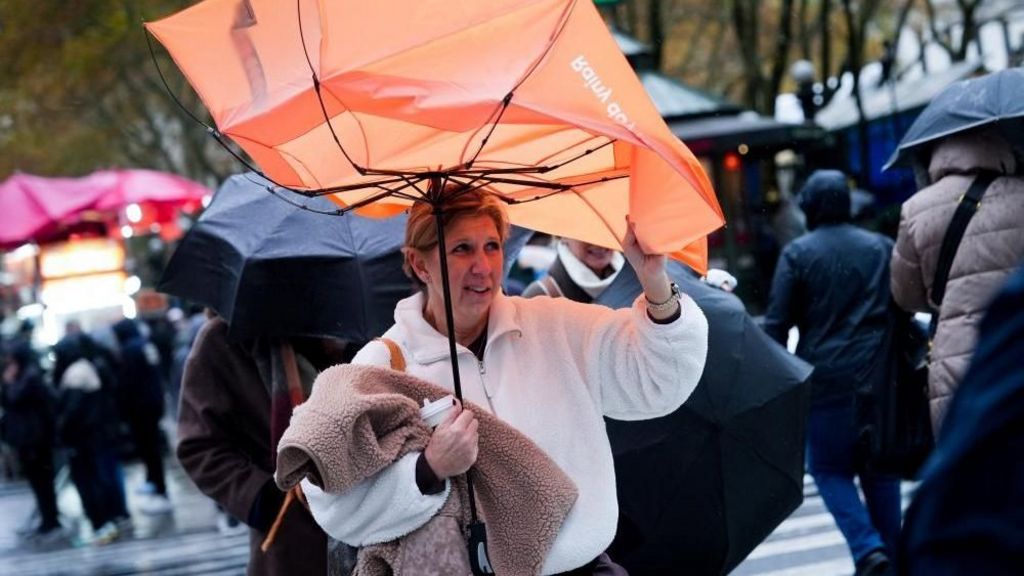
Hundreds of thousands of people remained without electricity following severe weather that impacted both the East and West coasts of the United States during the Thanksgiving holiday.
On Thursday, a strong storm brought heavy rainfall, high winds, and coastal flooding to eastern regions. Data from the tracking website Poweroutage.us indicated that Pennsylvania was the state most severely impacted by power outages early Friday.
Although weather conditions are expected to gradually improve, the National Weather Service warned that recovery efforts will take time. Meanwhile, the West Coast faced separate storm systems.
Travel disruptions continued as hundreds of additional flight delays and cancellations were recorded on Friday, which was anticipated to be another peak travel day.
According to Flightaware.com, more than 2,500 domestic and international flights involving the United States experienced delays on Thursday, while over 450 flights were cancelled.
An affected traveler reported to the BBC that he spent 13 hours stranded at New York's LaGuardia Airport while attempting to travel to Chicago to visit friends for the holiday.
In addition to transportation challenges, the severe weather caused extensive problems along the East Coast, prompting US President Donald Trump to state that he would evaluate the release of emergency funds.
High winds forced the closure of bridges in Maryland, and powerful waves struck Delaware beaches as water encroached onto the boardwalk.
Washington DC experienced its wettest Thanksgiving on record, with surging tidal waters flooding runways at Reagan Washington National Airport.
Outages reached nearly one million households on Thursday evening, heavily affecting Pennsylvania, Virginia, Maryland, and New Jersey.
Pennsylvania Governor Josh Shapiro noted that utility crews were working continuously to restore service. In Maryland, officials urged nearly two million customers to restrict water usage to essential needs only because of intermittent electricity failures.
States of emergency were declared in several areas of eastern states, including New York. Organizers in New York City also postponed the traditional Macy's Thanksgiving parade until Saturday.
On the West Coast, attention focused on unusually high tides and the threat of coastal flooding.
Earlier in the week, both Los Angeles and San Diego recorded high tides exceeding 8 feet, or 2.4 meters, leading authorities to warn beach visitors to stay away from the shoreline.
Amtrak canceled multiple services on the Pacific Surfliner route along the California coast due to track damage caused by high tides, according to announcements on social media.
In Oregon, police reported that a man and a dog were swept into the ocean by a powerful king tide, though both managed to escape without injury.
Flight operations in Miami experienced residual delays on Thursday after a FedEx aircraft overshot the runway the previous evening, resulting in the temporary closure of all but one runway.
In a statement issued to US media, FedEx confirmed that one of its aircraft encountered a landing incident. There were no injuries, and the Federal Aviation Administration opened an investigation into the event.
An airport staff member who spoke to CBS News on condition of anonymity suggested that wet weather could have played a role in the incident.
Prior to the holiday, the American Automobile Association estimated that 81.5 million Americans would travel a minimum of 50 miles away from their residences during the seven-day Thanksgiving travel window.