
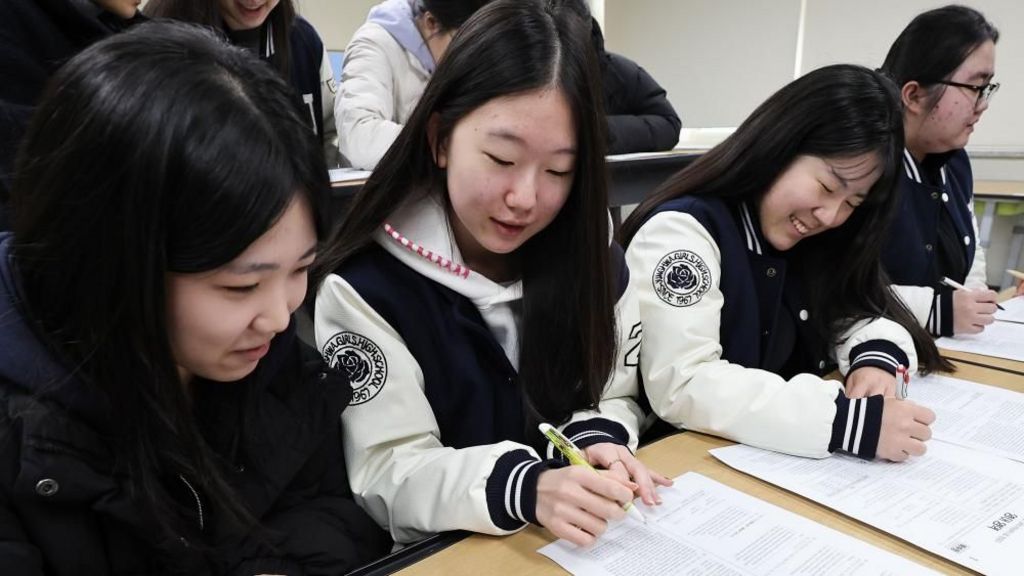
South Korean Education Minister Choi Kyo-jin has stepped down following a nationwide exam cheating controversy. He stated that he accepted complete accountability for the disruption caused by last-minute regulations designed to prevent artificial intelligence-assisted cheating during the Thursday Suneung annual college entrance examination.
Seven days prior, the highest-scoring candidate in the national tax accountancy examination confessed to utilizing a mini-camera, cellular phone, and artificial intelligence applications. This disclosure led authorities to implement urgent detection measures for concealed equipment, which included broadcasting emergency notifications to every cellular phone nationwide.
The Suneung requires up to nine hours to finish and significantly impacts the professional paths of millions of South Koreans.
Choi was cited by the South Korean news agency Yonhap on Sunday stating, As the minister in charge, I believe I cannot escape criticism that we failed to prepare in advance.
The minister further noted, Now that the exam has concluded, I feel a deep sense of responsibility and am offering my resignation.
President Lee Jae Myung of South Korea, who has advocated for a restructuring of the existing examination framework, subsequently approved Choi's departure.
The ministry of education previously reported that 111 test-takers were discovered possessing prohibited smart devices during the current year's Suneung, which involved approximately 500,000 participants.
Apprehensions regarding academic dishonesty during the highly competitive assessment had intensified recently following accounts of candidates utilizing artificial intelligence tools to cheat.
These anxieties culminated the preceding weekend when Han Won-seok, who achieved the highest score on the April tax accountancy examination, confessed to academic dishonesty.
His admission followed questions regarding his exceptional score, which featured only a single incorrect response out of 160 questions.
The 34-year-old stated in a video message, I used a microcamera to photograph the test questions and sent them to an AI, then checked my answers on my smartphone to commit the cheating.
This confession compelled officials to enact emergency procedures merely days prior to the Suneung administration.
These actions involved broadcasting national emergency notifications on the date of the examination.
Three notifications were transmitted between 08:00 and 15:00 local time on Thursday, triggering mobile phones across the nation to sound simultaneously, including devices set to silent mode and those belonging to international visitors utilizing data roaming services.
Mobile devices did not sound if they were powered down or placed in airplane mode.
This marked the initial instance of South Korea utilizing its national disaster notification framework to identify examination cheaters.
Participants were additionally required to conceal buttons on their upper garments to obstruct potential concealed cameras, while officials performed examinations of eyeglasses.
These protocols induced anxiety even among law-abiding candidates.
Prior to the Suneung, a high school senior informed the Korea Times that he feared his horn-rimmed spectacles might be confused with smart glasses.
Another participant informed Yonhap that he typically wore spectacles but chose to wear contact lenses for the Suneung to prevent generating suspicion.