
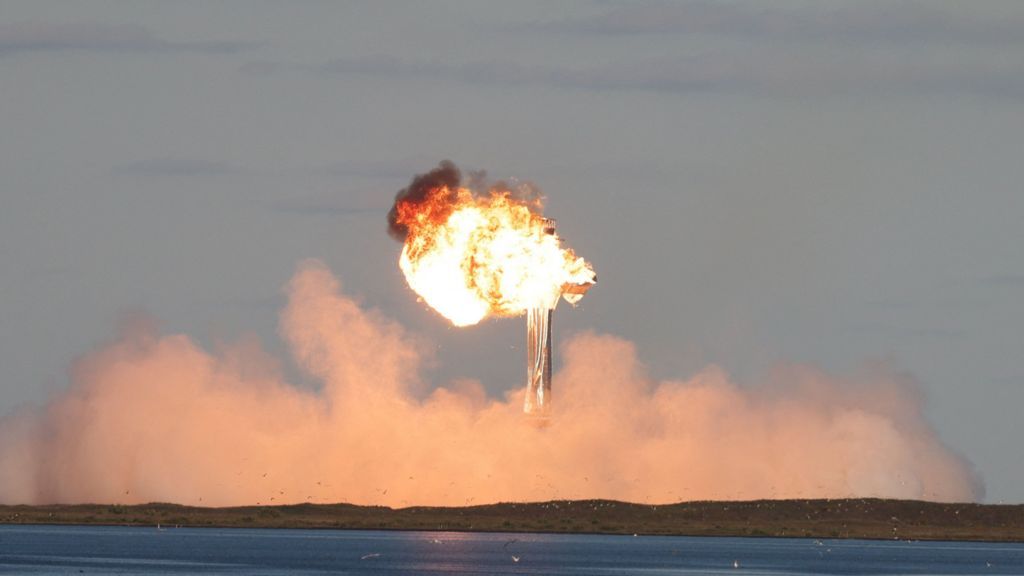
SpaceX canceled its plan to catch the lower portion of its massive Starship rocket during its recent test flight.
The objective was to capture the vehicle using the mechanical arms, known as chopsticks, on the launch tower as it descended back to Earth, but the booster was instead redirected to the ocean, where it erupted in flames upon impact.
The upper section of the rocket proceeded with its flight into orbit, with SpaceX slated to determine whether to attempt catching this stage at approximately 15:15 local time (21:15 GMT) on Saturday.
This marks the organization's initial attempt to fully retrieve its rocket, creating a path toward making Starship completely reusable to enable frequent flights and lower expenses.
The 124m-tall rocket successfully lifted off from the Starbase launch facility in Boca Chica, Texas at 16:45 local time (22:45 GMT) on Friday.
Recovery of the lower component, the Super Heavy booster, was scheduled for six and a half minutes later upon its return to the launch structure, but it was redirected to the sea instead.
During the launch broadcast, a SpaceX representative stated, "Safety is always the number one priority, and we're still testing out things that we haven't done before on these vehicles, and so we are prioritising making sure that we can perform each maneuver safely."
The upper section, designated the Ship, continues its journey into space, where it is deploying 26 satellites to expand the Starlink constellation that delivers high-speed internet globally.
The Ship is scheduled to finish 14 orbits around the Earth before heading back to the launch tower 22.5 hours post-launch, potentially setting up a second capture attempt.
SpaceX has successfully caught the Super Heavy Booster during three prior test missions.
Conversely, the upper stage, which first reached orbit in September, has never been secured by the chopsticks and has historically splashed down in the ocean.
Prior to launch, SpaceX indicated that any attempt to recover the Ship would depend on a thorough evaluation of the vehicle while operating in space.
Should any anomalies arise, multiple contingency points exist during the mission to direct the rocket stage down into the ocean.
Creating a fully reusable rocket remains a long-standing objective for SpaceX.
Back in 2015, the firm achieved the first vertical landing of a rocket segment utilizing its Falcon 9 booster.
Falcon 9 rockets currently fly more than 100 times annually, and the capability to recover the lower section has significantly reduced launch costs.
However, successfully landing an entire Starship system could elevate this progress further, according to Prof Malcolm Macdonald, president of the Royal Aeronautical Society.
"Full reusability has the potential to fundamentally change the economics of accessing space," he noted.
"One successful flight will not prove that model, but it could mark an important transition: from demonstrating that Starship can fly, to demonstrating how Starship could operate."
Following SpaceX going public earlier this year, company investors and the US Space Agency are closely monitoring the test.
Starship's progress carries direct implications for NASA's goal to land astronauts on the Moon by 2028, a highly challenging timeframe.
SpaceX secured a NASA contract to adapt the Ship into a lunar lander capable of transporting astronauts to the Moon's surface.
Nevertheless, SpaceX is not the sole contractor collaborating with NASA, as Blue Origin, founded by tech billionaire Jeff Bezos, also holds an agreement to utilize its New Glenn rocket and lander for lunar touchdown.
Both enterprises will play vital roles in Artemis III, currently scheduled for the summer of 2027, another demanding timeline.
This mission involves four astronauts aboard NASA's Orion spacecraft attempting to dock with landers provided by both SpaceX and Blue Origin.
Starship must achieve substantial advancements in the coming months to fulfill these obligations, as development velocity has lagged behind internal SpaceX projections.
Simultaneously, Blue Origin faces its own extensive workload following a major incident earlier this year when a rocket explosion completely destroyed its Florida launch facility.
Blue Origin previously targeted a return to operations by the end of the year, but flight resumption has now shifted to early 2027.
NASA faces mounting pressure to hit its scheduling milestones, with administrator Jared Isaacman noting that the United States is engaged in a space race with China, which aims to land taikonauts on the Moon by 2030.