
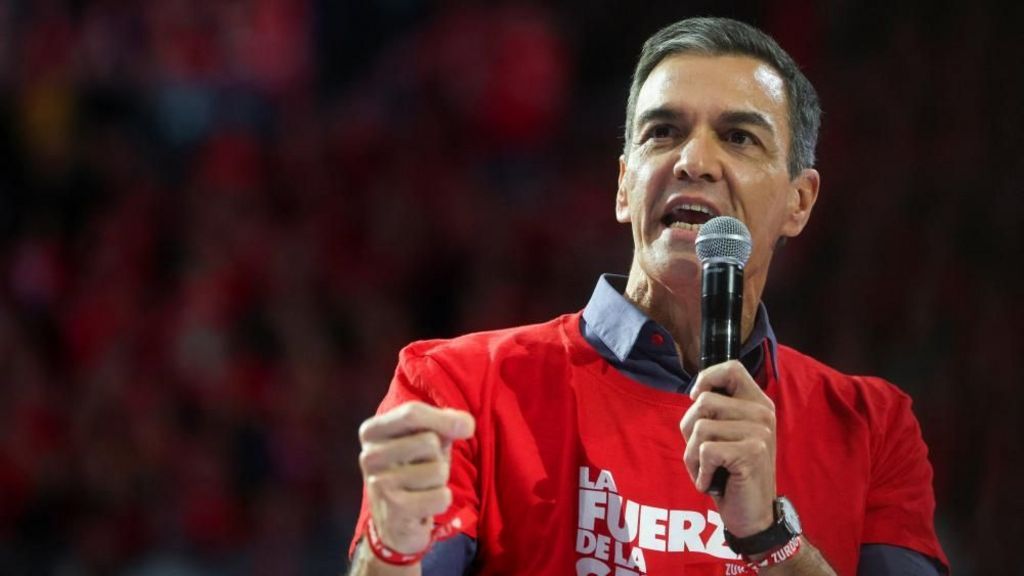
Spain's main political leaders concluded their election campaigns ahead of Sunday's vote, with Socialist Prime Minister Pedro Sanchez expressing confidence that he would defy current polling predictions. I cannot imagine us losing, he stated while taking photographs with supporters wearing red T-shirts, and he alleged that his conservative opponent Alberto Nunez Feijoo intended to form a coalition with the far-right.
Feijoo and his People's Party hold a narrow lead in opinion polls, and in the final hours of the campaign he traveled to Barcelona and Seville to promise voters a political era defined by truth, decency and good governance. He criticized Sanchez for avoiding questions regarding corruption, rail incidents, immigration levels and national debt.
The incumbent Socialist leader heads one of Europe's remaining left-wing administrations, and with French presidential elections approaching in five months, two of the continent's major economies could potentially shift toward the right. Nearly 39 million citizens are eligible to vote in Spain, and while high turnout is anticipated, polls indicate a tight outcome, with no surveys published since Monday under national electoral regulations.
This time, yes, we are going to do it, Feijoo told supporters of the People's Party, referencing his previous inability to form a government three years ago despite securing the highest number of seats. Should he successfully form an administration following this election, it would rely on backing from the anti-immigration party Vox, led by Santiago Abascal, whose final event drew thousands of attendees to a bullring in Valencia on the eastern coast of Spain.
The venue was decorated with Spanish flags and green banners associated with Vox, and the crowd responded enthusiastically when the party's secretary general called for less burka and less halal. Ignacio Garriga stated that his motivations stemmed from affection for the country rather than animosity, while a small group of attendees chanted Viva Franco in memory of the dictator whose death in 1975 marked the beginning of Spain's transition toward democracy.
Several first-time voters at the rally indicated they supported Vox because of its stance on immigration. An eighteen-year-old named Lledo mentioned that events in Ceuta during the summer, when more than 70,000 migrants crossed from Morocco into Spanish territory, demonstrated that Sanchez was incapable of managing national borders. She attended the event alongside her mother and her aunt Carli Chilet, who asserted that Vox represented the best option for women's rights.
Vox aims to significantly increase its representation beyond the 33 seats secured three years ago. The party advocates for national priority policies that favor Spanish citizens regarding welfare services, alongside remigration measures for foreign nationals deemed not to contribute economically.
The final day of campaigning unfolded in the context of a four-way television debate held the previous night, which highlighted deep political divisions in Spain. All four candidates presented proposals addressing the housing crisis, with Feijoo promising the construction of one million homes over four years, while Sanchez maintained that housing should constitute a right rather than a speculative asset.
While conservatives concentrated on scandals that affected the Socialist administration, Sanchez and his left-wing ally Ada Colau, leader of Frente Amplio, emphasized women's rights. The two politicians highlighted a moment during the debate when the leader of the People's Party accused Colau and other left-wing figures of remaining silent during flood disasters in Valencia, using a condescending diminutive form of the word quiet.
Sanchez responded immediately by demanding respect and labeling the remark as sexist. Feijoo addressed the comment on Friday and criticized Ada Colau for remaining silent throughout years of corruption. His decision to conclude his campaign in Seville was strategic, given that the Andalusia region accounts for 61 seats in the 350-seat national parliament, representing the largest regional share.
Andalusia is also governed by a coalition involving the People's Party and Vox, mirroring regional governments in Extremadura, Aragon, and Castilla y Leon. Feijoo has stated his intention to govern with a majority supported by parliamentary agreements with Vox, noting that he has never discussed ministerial appointments with Abascal.
Governing is about managing, and I have spent my whole life preparing for this moment, Feijoo declared in Seville. Among his new supporters was a retired woman named Isabel, who told public broadcaster RTVE that she attended a People's Party rally for the first time after becoming disillusioned with the Socialist leadership.
Sanchez appeared on stage in Madrid accompanied by his wife Begona Gomez, wearing a red T-shirt featuring the slogan power of the people. He subsequently praised the campaign conducted by Colau and her left-wing coalition. These elections are about moving Spain forward, not taking it backwards, he stated.
Socialist supporter Leon Felipe told Reuters that the election represented a critical turning point rather than a routine change of government, warning of a potential return to the dictatorship of Franco and urging young people to vote. Simultaneously, Colau addressed an audience in southern Madrid, vowing that her coalition would not remain silent and would secure victory to establish another progressive government.