
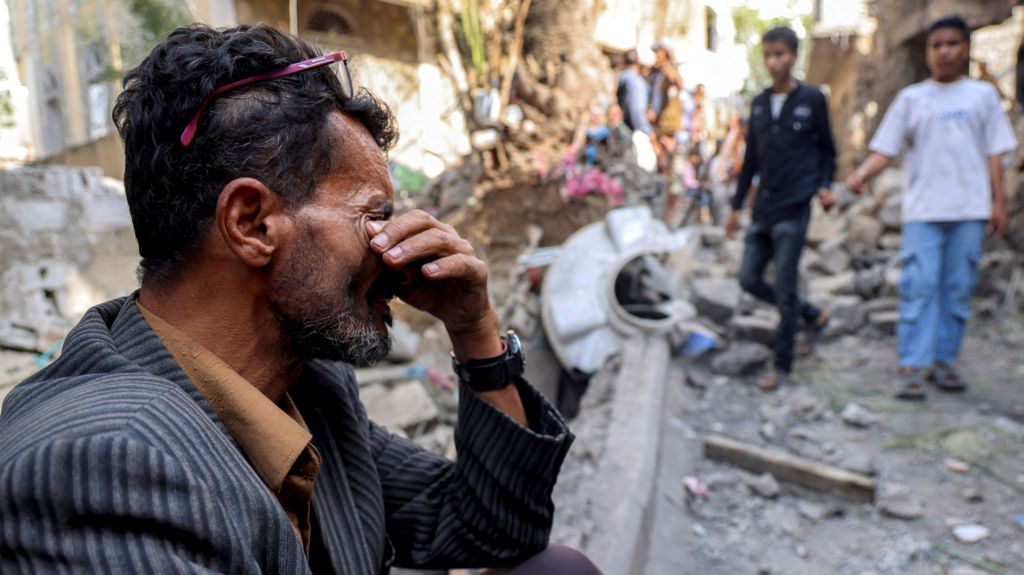
In the Yemeni city of Taiz, surrounded by steep mountains and Houthi rebel forces, a mother named Ashwaq copes with her frightened child by resorting to deception. When her 11-year-old son hears loud noises, she reassures him that it is merely fireworks, though she knows he is old enough to understand the reality of a war that has defined most of his life.
Taiz has long served as a critical front line in Yemen's civil war. Houthi fighters tightened their positions last month, completely surrounding the government-held city and its population, estimated between 600,000 and one million residents.
Since then, Yemen's third-largest city has been isolated from the outside world. Interviews with seven residents revealed detailed accounts of severe shortages, with only minimal food entering the area and the prices of staples like rice, sugar, and cooking oil doubling or tripling, alongside dwindling supplies of medicine, water, and fuel.
Streets that once bustled with traffic and conversation are now silent, schools and restaurants are closed, and uncollected rubbish creates toxic smoke when residents attempt to burn it. Rebel fighters and snipers positioned on surrounding hills maintain control over the city below.
The local Office for Siege Affairs reports that 148 civilians have been killed by Houthi attacks since August, though death toll estimates vary widely. Many residents interviewed declined to be identified due to safety concerns and fear of Houthi surveillance through controlled mobile carriers.
Ashwaq, a teacher and mother of three, describes the city as feeling like a massive prison. She keeps her children indoors due to constant shelling and sniper fire near the front lines, worrying about their safety every minute of the day.
As the gateway to Aden and southern Yemen, Taiz has experienced conflict for over a decade. Iran-backed Houthi rebels reached the city's outskirts in 2015 after seizing the capital, Sanaa, a year earlier. Despite Saudi backing and airstrikes, the fractured government has been unable to reclaim the north-west, and recent months have seen an escalation in the conflict.
An emergency room doctor named Yaser witnesses the toll of the conflict daily, having recently treated four children shot in the head or chest by Houthi snipers, two of whom died. He notes that most injuries result from shelling, and the hospital struggles with severe shortages of supplies, including surgical sterilisation fluid, leaving facilities with perhaps two weeks of operational capacity remaining.
Governor Nabil Shamsan states that funerals have become a constant presence in Taiz as residents succumb not only to violence but also to supply shortages, food scarcity, and loss of income. He reports that hospitals have lost 70% of their capacity, 120 health centres have closed, diseases are spreading, and malnutrition is surging.
While Houthi leader Abdul Malik al-Houthi has denied that Taiz is besieged, claiming routes remain open for aid, this assertion is disputed by the government, residents, aid agencies, and the United Nations. Governor Shamsan argues that the Houthis aim to dismantle the city's cultural and civic identity and impose strict religious doctrine.
Residents and pro-government brigades are actively defending Taiz despite a lack of heavy weapons and numerical disadvantage. Akram, a 31-year-old volunteer who took up arms after the 2015 encirclement, recently purchased a Chinese Kalashnikov rifle for about $1,200 as fighting intensified with new Houthi technology and drones. Although designated as a foreign terrorist organisation by the United States, the armed group is not classified similarly by the UK or the European Union.
Nighttime brings no relief, with photographer Ahmad Al-Basha noting that bombing and shelling continue after dark. Residents express frustration over perceived abandonment by their government and the international community.
As the siege persists, Ashwaq appeals to the world not to forget Taiz, emphasizing that its inhabitants are ordinary families whose children deserve to live without the constant fear of war.