
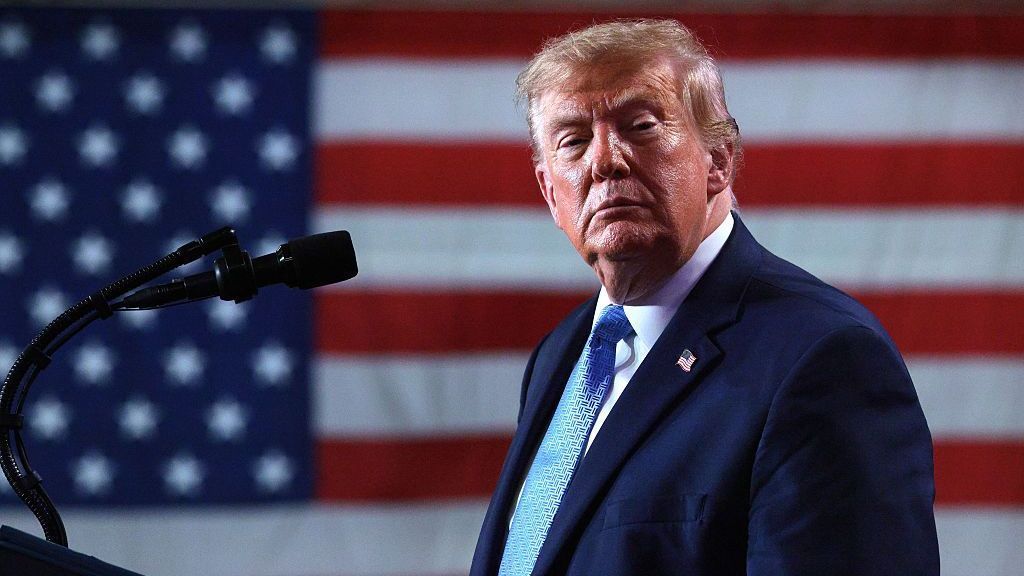
US President Donald Trump has expressed doubts about the validity of the midterm election outcomes that resulted in major defeats for Republicans, just days after stating that he would accept the results.
Does anybody really believe that this Election was honest. How could the Polls be so wrong? Trump wrote on Truth Social on Monday.
This statement appeared to contradict his remarks to the New York Times on election night, when he stated that he was absolutely willing to accept the results.
Democrats regained control of both congressional chambers in the elections held last week. Election authorities at the state and local levels across the country reported that the voting process was largely smooth and without major issues.
Certain important contests, such as Senate races in Alaska and Mississippi, remain undecided.
In his Truth Social message, Trump made general assertions regarding polling, ballot drops, and voting machines, but did not offer concrete proof regarding what these comments meant or whether he suspected fraud or mistakes.
Vote tabulation on election night followed standard procedures, according to Charles Stewart III, a political scientist at the Massachusetts Institute of Technology.
We saw across the nation the standard patterns we see in terms of when the votes are reported, he stated.
Stewart noted that certain states, such as Florida and Georgia, report initial results quickly because they process early and mail-in ballots in advance.
Trump has previously sought to question the fairness of elections he has lost, although he was not a candidate in the midterm elections.
We would have won easily if I was on the ballot, Trump told CBS News, the BBC's US partner, after confirmation that his party had lost majorities in both the Senate and the House.
Pre-election surveys conducted by various polling organizations and news organizations indicated that Republicans were at risk of losing seats in both the House and Senate.
Presently, Democrats have secured 54 seats in the US Senate and 254 seats in the US House during the midterms, providing them with solid majorities in both legislative chambers while vote counting persists in select races.
Media networks have not yet projected winners for certain pivotal races, including the Senate seats in Alaska and Mississippi.
State laws and practicalities are such that some states will just take longer to count, explained Ruth Greenwood, director of the Election Law Clinic at Harvard Law School.
That doesn't mean anything nefarious is occurring—we just need to trust local election officials to count every vote and tell us the results when they are done.
The election outcome has been apparent since election night. Trump told the New York Times at the time: We'll, you know, look forward to working with [Democrats], adding: We'll probably work something out.
He also provided his perspective on the Republican defeat, admitting on Fox News that the conflict involving Iran played a role in the losses.
People agree with what I'm doing on Iran but they really probably weren't willing to do the short term consequences of paying more for gasoline - I understand that, he remarked.
Vice-President JD Vance likewise attributed the party's defeat to the war with Iran, which started in February and has heavily impacted international oil and gas markets, leading to a sharp rise in energy prices.
Before the midterm elections, Trump asserted that widespread voting fraud would occur, despite studies showing that such fraud is uncommon.
He and his supporters maintained for months that the 2020 presidential election, which he lost to former President Joe Biden, was manipulated against him. His legal team and allies spent weeks trying to challenge the results through legal action, but judges consistently dismissed their claims.
The justice department during his administration undertook significant efforts to increase federal oversight of elections, a responsibility that the Constitution assigns primarily to individual states.
Prior to the midterms, the administration initiated controversial federal lawsuits challenging vote tabulation and certification processes in states such as California and Alaska, though judges rejected nearly all of these challenges.
Legal scholars specializing in election law, state administrators, and local election offices informed the BBC that they spent months preparing for the possibility that the White House or election doubters would challenge the validity of the ballots.
Despite significant attention on election security from all political perspectives, senior state and local election officials characterized the overall voting process for the 2026 midterms as generally orderly.
Severe weather conditions did necessitate the closure of some polling sites, and a small number of administrative and technical difficulties caused minor delays in certain jurisdictions.