
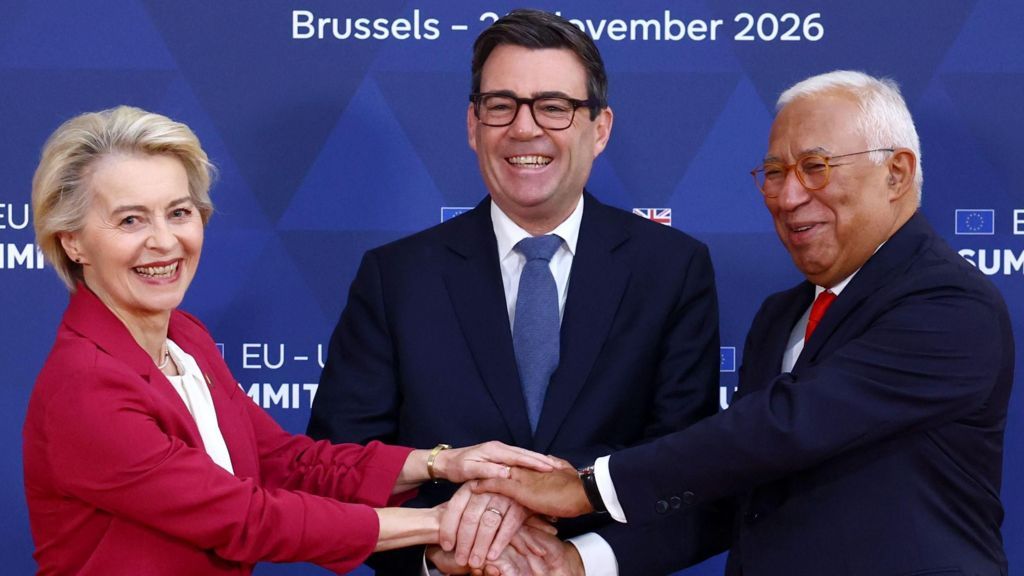
Andy Burnham announced that the United Kingdom will examine potential pathways for deeper integration with the European Union after securing an agreement that addresses British food exports, emissions trading, and a youth mobility framework.
The prime minister described the outcome as a positive development for both Britain and Europe, noting that Treasury projections indicate the arrangement could increase the UK economy by up to 17 billion pounds annually. European Council President Antonio Costa stated that the EU remains prepared to establish the closest feasible association with the UK.
Conversely, Conservative leader Kemi Badenoch asserted that the agreement is unfair, while Reform UK leader Nigel Farage characterized it as a betrayal of the British public. Legislative measures required to enact the accord are anticipated to be presented to the UK Parliament in the following week.
Burnham traveled to Brussels to conclude the current phase of the administration's post-Brexit relationship reset, which commenced under former prime minister Sir Keir Starmer. The agreements revealed on Friday involve the elimination of most inspections on British agricultural exports starting in 2028, provided the UK aligns with specific EU regulations.
While the British government maintains that these adjustments will decrease expenses for enterprises and potentially lower consumer costs, detractors contend that the arrangement transforms the UK into a rule taker rather than a rule maker. The new youth experience initiative will enable up to 100,000 individuals aged 18 to 31 from the EU to reside, labor, and study in the UK for a maximum of three years, with an equivalent quota of young Britons granted access to Europe. Both administrations aim to operationalize the annual program by January 2030 at the latest.
An additional six-month window is designated for negotiations regarding tuition costs, which could present a significant obstacle. European officials have advocated for reduced fees for EU students attending British institutions, and the joint declaration specifies that any resulting policy would apply equally to UK students within the EU. European Commission President Ursula von der Leyen expressed optimism that a resolution will be reached, to which Burnham responded affirmatively.
Regarding migration, the UK and the EU have pledged to collaborate closely to combat human smuggling networks and migrant trafficking, alongside expectations for law enforcement bodies to increase data sharing. Burnham noted that substantial headway has been achieved in disrupting criminal syndicates facilitating hazardous crossings across the English Channel. Furthermore, joint communications confirmed that discussions regarding the integration of the UK and EU emissions trading frameworks have concluded, with implementation targeted for 2028.
Burnham contended that survey data indicates public support for stronger connections with the EU and that the current arrangement fulfills that mandate. He emphasized the necessity of evaluating long-term structural relationships, stating that incremental adjustments have limited efficacy. The prime minister announced that his administration will release a ten-year strategy next month outlining goals for reindustrialization, national growth, and youth opportunities, which he connected to the future partnership with neighboring nations.
Ahead of the upcoming UK-EU summit, both administrations intend to pursue informal discussions to explore long-term structural options. Burnham observed that the current announcements likely represent the maximum achievable scope during the present parliamentary term due to implementation requirements, though the findings will inform subsequent parliaments in determining future policy.
Although Labour's 2024 general election platform explicitly ruled out returning to the single market, the customs union, or freedom of movement commitments which Burnham reaffirmed the prime minister maintained that the electorate will ultimately dictate subsequent developments prior to the election required by August 2029. Von der Leyen characterized the summit as a pivotal moment for bilateral relations and confirmed openness to exploratory dialogue.
Badenoch criticized the agreement as inequitable, arguing it forces British farmers to adhere to external regulations while increasing foreign competition for domestic youth seeking employment. Addressing the Treasury analysis cited by Burnham regarding a 0.5 percent GDP increase, Badenoch claimed the figure was unfounded, citing alternative modeling indicating a zero percent impact. Farage described the agreement as a victory for the EU aimed at marginalizing the UK, labeling Burnham a fraud on social media and asserting that only Reform UK can prevent ongoing betrayals of the public.
Liberal Democrat leader Sir Ed Davey argued that the relationship requires more than minor adjustments, calling the youth mobility initiative insufficient and demanding a comprehensive new arrangement for the country.