
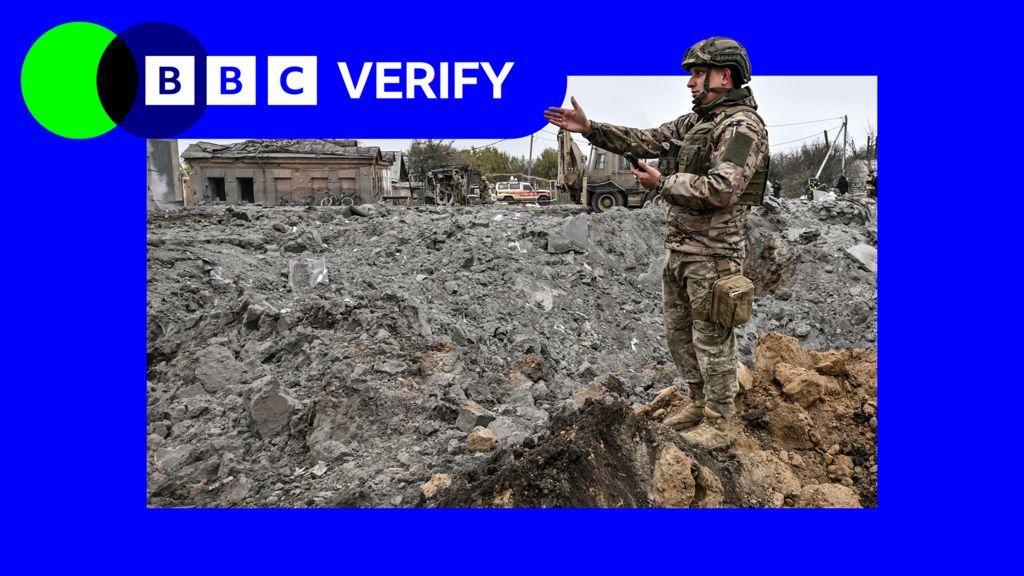
Ukrainian officials have stated that Russia deliberately targeted rescue and recovery efforts following a devastating double-tap attack in a front-line village that left at least 72 people dead two weeks prior.
According to Ukraine, Russian forces conducted two consecutive strikes on a humanitarian aid center located in the village of Komyshuvakha on November 2. Officials reported that the second strike utilized a 3,000kg aerial bomb directed at a shelter where local residents had sought refuge.
Verified images published in the aftermath of the assault depict damage sustained by emergency vehicles and excavation machinery at the location.
The State Emergency Service of Ukraine reported to BBC Verify that multiple Russian strikes occurred during the ongoing rescue operations.
The agency noted that three police officers, four workers, and two rescue dogs sustained injuries, while five vehicles suffered damage.
Emergency personnel have been repeatedly compelled to suspend their operations and seek shelter due to the constant threat of renewed shelling, the agency stated.
The death toll has climbed to a minimum of 72 individuals, positioning this event as one of the single most fatal incidents since the onset of Russia's full-scale invasion of Ukraine in February 2022.
An intelligence officer investigating the case for the SBU security service, identified only by his first name Oleksiy, stated that rescue vehicles displayed clear markings and accused Russia of intentionally destroying humanitarian assets.
He further stated that local infrastructure and remaining residents in Komyshuvakha face systematic targeting by drones and bombs, accusing Russian forces of engaging in outright terror against civilians to render front-line life unsustainable.
BBC Verify authenticated videos shared by Ukrainian police featuring rescue workers shouting warnings about drones and seeking cover the day after the November 2 attack, alongside footage of a group treating a victim.
Oleksiy noted that recovery of bodies from the debris remains ongoing, adding that the adversary is fully aware that an active humanitarian operation to locate the deceased is taking place.
BBC Verify reached out to the Russian Ministry of Defence regarding the Komyshuvakha strikes but received no reply.
A broader statement issued by the Russian military on November 2 indicated that strikes had been conducted against energy and transport infrastructure utilized by the Ukrainian military nationwide.
While Komyshuvakha contains no military or industrial sites, it sits near a crucial transit corridor used for Ukrainian troop movements, supply transport, and evacuations. The village was previously reported to have been targeted by Russian fire on October 28.
Local residents gathered at the shelter area on November 2 after receiving instructions via a local Telegram channel regarding aid distribution scheduled between 10:00 and 12:00 local time. Ukrainian authorities reported that an initial strike at 09:45 local time struck surface-level buildings, resulting in the death of one woman.
Bodycam footage released in edited segments by Ukrainian police and analyzed by BBC Verify captures individuals attempting to extricate a victim from rubble before confirming her death.
Throughout the video, warnings regarding a secondary impending strike can be heard over police radios with escalating urgency until individuals are directed to enter the underground shelter.
Captured approximately an hour after the initial strike, the footage subsequently shows individuals waiting silently in a shelter before a massive explosion occurs and the recording turns dark.
Subsequent aftermath footage displays bodies being extracted from a large crater situated directly above the shelter, revealing twisted metal and structural debris beneath the surface.
Funerals for the victims have occurred on an almost daily basis, encompassing locals involved in aid distribution, those gathering supplies, and soldiers who reportedly arrived to support rescue efforts.
Trevor Ball, a bomb disposal specialist with the intelligence firm Armament Research Services, indicated that the crater visible in the footage corresponds with the dimensions and penetration depth characteristic of a FAB-3000, a 3,000kg Russian weapon capable of breaching underground infrastructure.
Chris Proops, a former investigator with the UK National Crime Agency, supported this assessment, stating that the scale of destruction aligns with the size of a FAB-3000.
Both experts confirmed that verified photographs of munition fragments obtained from Ukrainian authorities by BBC Verify depict components of a guidance kit compatible with the FAB-3000, which enhances accuracy and permits long-range deployment.
International law specialists told BBC Verify that executing intentional attacks against rescue personnel constitutes a war crime for Russia.
Ben Saul, a professor of international law at the University of Sydney, stated that the incident appears to represent either a deliberate assault on civilians and civilian objects or an indiscriminate attack, both of which constitute war crimes.
Professor Samuel Moyn of Yale University stated that directly targeting rescuers or their equipment represents a severe breach of international humanitarian law, adding that necessary precautions must be implemented to ensure strikes target combatants rather than other populations.