
The US Federal Aviation Administration has lifted the longest nationwide ground stop of flights since the 11 September 2001 attacks.
The FAA stated that the Friday stoppage, lasting over four hours, occurred because of extraordinary circumstances stemming from a communication issue that impacted all air traffic control centres.
Homeland Security Secretary Markwayne Mullin indicated there was no sign of a cyber-attack and assured that everyone remained safe.
Here are the established details.
How many flights were affected?
According to FlightAware, the ground stop resulted in more than 8,500 delays and nearly 8,000 cancellations on Friday.
The initial announcement from the FAA at 15:54 EST (20:54 GMT) specified that all flights departing within the US would be grounded until further notice.
At that moment, more than 3,500 aircraft were airborne. While some were diverted to alternative airports, others continued to their original destinations.
Operations resumed hours later when certain departures were permitted from San Francisco International airport.
The Federal Aviation Administration reopened the airspace until 20:15 EST.
What about international flights?
All air traffic bound for the US from member states of Eurocontrol was suspended.
Eurocontrol comprises 42 member states, including numerous EU nations, the UK, Turkey, Israel, and Morocco.
Travelers departing from the UK received warnings regarding potential disruptions on Saturday morning.
Although multiple flights to the US from Heathrow airport faced cancellations and delays, Manchester airport reported that no major disruptions were anticipated, and Gatwick airport operated normally.
Sydney airport, Australia's largest international facility, initially grounded all US-bound services, though scheduled departures are now expected to proceed as planned.
Additionally, Air Canada cancelled its routes operating between the US and Canada.
When will normal service resume?
During a Friday evening news conference, US Transportation Secretary Sean Duffy stated that the system outage will create a ripple effect lasting several days.
Duffy noted that unwinding the events of the afternoon would require considerable time.
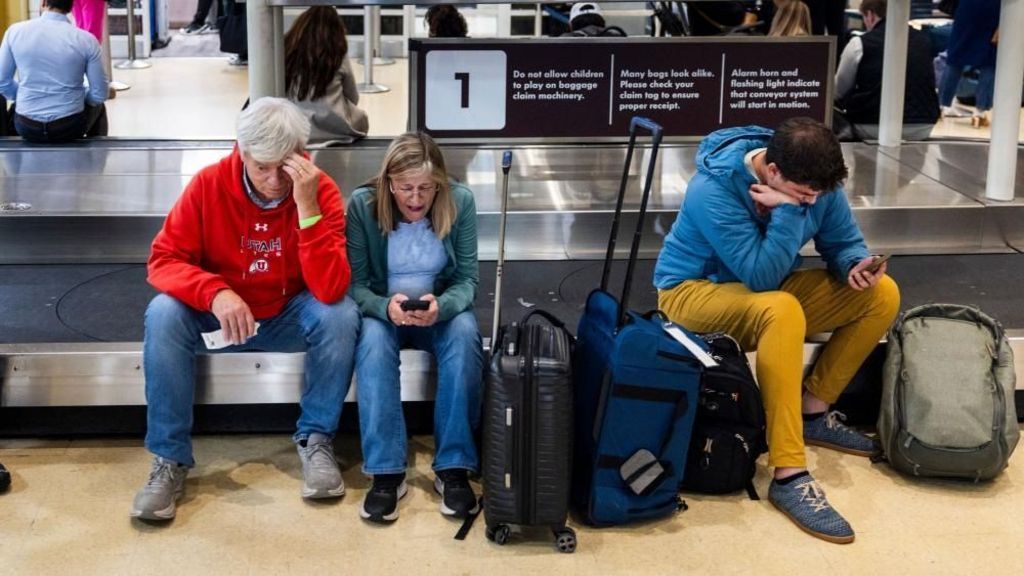
Thousands of individuals were stranded at airports nationwide, with Duffy observing that many lacked any knowledge of where they would sleep that night.
Delta Air Lines and United Airlines announced the resumption of their operations.
American Airlines concentrated on operating as many remaining flights as possible that evening, while JetBlue planned to resume services on Saturday morning.
British Airways advised affected passengers on US routes to verify their flight status while still traveling to the airport as scheduled.
What are your rights?
Within the US, UK, and EU, airlines may bear liability for compensation if a delay's cause falls under their control, such as a mechanical fault or pilot illness.
Consequently, airlines are not obligated to compensate passengers for disruptions caused by air traffic control issues.
Nevertheless, passengers retain specific protections under US federal regulations and local laws.
Under the FAA Reauthorization Act of 2024, canceled or significantly delayed flights—defined as three hours for domestic routes and six hours for international travel—must receive alternative travel arrangements or a full fare refund if the passenger opts not to fly.
The legislation also mandates that air carriers issue refunds within seven business days for credit card purchases and 20 days for alternative payment methods upon request, though passengers who accept a new flight forfeit refund eligibility.
US carriers are not legally required to provide meal vouchers or accommodations, though certain airlines may offer complimentary support.
Passengers traveling from the UK to the US or flying with a UK carrier may possess supplementary rights.
Under UK legislation, airlines hold a responsibility to assist passengers during delays or cancellations regardless of the cause.
This obligation encompasses providing a reasonable quantity of food and drink, communication access, complimentary overnight accommodation when necessary, and transportation to and from the lodging.
Should an airline fail to arrange this assistance, travelers are entitled to organize it independently and seek reimbursement subsequently.
The Civil Aviation Authority recommends retaining all receipts and avoiding excessive expenditures.
What caused the ground stop?
Duffy explained that a legacy air traffic control communications system experienced data overload.
Duffy stated that analogue telecommunications switches and routers became overloaded with data and failed.
This failure impacted both communications and radar systems, which Duffy described as requiring a complete overhaul with an estimated cost of 50 billion dollars, warning that the equipment will continue to fail.
Homeland Security Secretary Markwayne Mullin reiterated during the press conference that zero evidence pointed toward a cyber-attack.
He also dismissed any connection to the global Microsoft outage that began on Thursday.
Mullin attributed the failure to the integration of new technology into an aging air traffic control framework, which overwhelmed the system.
Both cabinet officials maintained that the general public was never placed in danger during the stoppage.
When was the last ground stop?
This event marked only the second nationwide stoppage since the immediate aftermath of the 11 September 2001 plane hijackings orchestrated by al-Qaeda.
Dr Guy Gratton, an associate professor of aviation at Cranfield University, told BBC Verify that while it appeared to be the worst incident since 9/11, it did not reach that scale.
Gratton referenced a previous US grounding in 2023 caused by a failure within the Notice to Air Missions system.
That incident persisted for one hour and 52 minutes, resulting in approximately 9,500 delayed flights and 1,300 cancellations.
The 2023 disruption prevented the publication of air traffic safety notices, leading to a complete ground stop until the system recovery.