
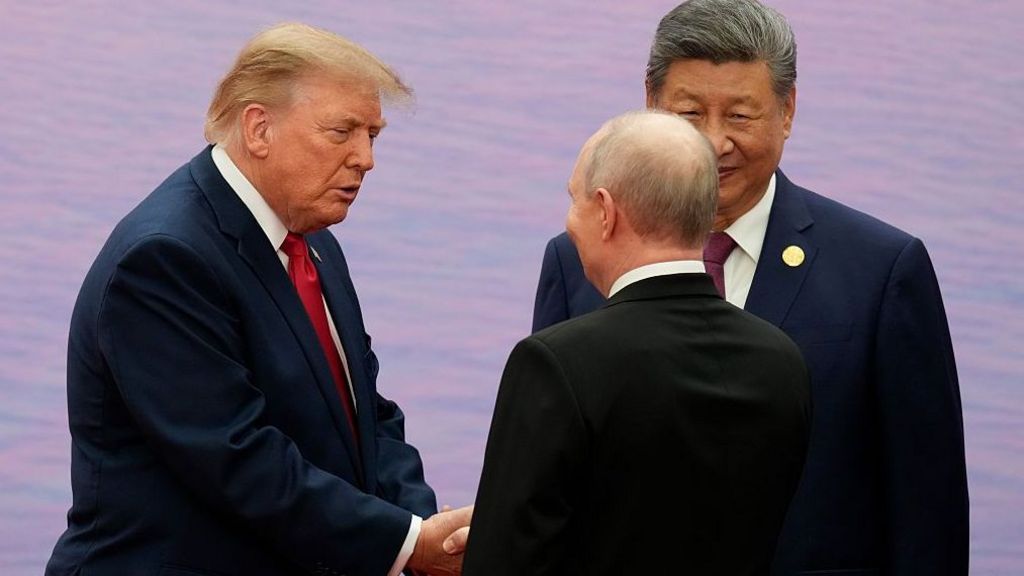
Chinese leader Xi Jinping has orchestrated a historic diplomatic gathering in Shenzhen, bringing together Vladimir Putin and Donald Trump in an event that underscores China's growing influence on the global stage. For decades, Washington and its western allies shaped the international order, but Beijing is now at the heart of discussions reshaping global politics. Set against a futuristic backdrop of driverless cars, flying drones, and dancing robots, the summit ostensibly focuses on Asia-Pacific economies, yet it serves as a powerful demonstration of China's economic and political reach. However, the meeting presents significant challenges for Xi, who faces several sensitive issues he would prefer to avoid.
The first major complication involves the war in Ukraine, which is now well into its fifth year and which China would rather keep off the agenda. Xi faces a delicate balancing act, as his ties with Putin threaten to harm European relations, which are vital for China's export-driven economy. At the same time, Beijing does not want the conflict to end in a manner that destabilizes Russia, a crucial neighbor and ally. While maintaining a stance of neutrality and calling for a political settlement without condemning the invasion, China has faced accusations from Europe and the US, particularly under the previous Biden administration, of supplying war components and purchasing Russian oil and gas. Xi aims to keep Putin close enough to maintain the alliance, yet distant enough to avoid absorbing Russia's problems.
Another contentious topic is China's expanding nuclear arsenal, which Donald Trump insists should be part of discussions to limit global nuclear weapons. Although the US and Russia hold the world's largest stockpiles, China's rapid military expansion has alarmed Washington. Following the expiration of the New START arms control treaty in February of this year, fears of a new arms race have grown, and Trump wants Beijing included in any future framework. China has resisted this push, arguing that its smaller arsenal makes parity unfair and that it must retain the freedom to develop its capabilities. This disagreement could hinder Xi's desire for global recognition, as the US contends that leadership entails the responsibilities of a major nuclear power.
Managing the optics of the summit poses yet another challenge, as Xi typically relies on meticulously planned agendas and choreographed speeches. In this unprecedented meeting, he must contend with two highly unpredictable leaders who possess their own distinct agendas, with the US President already threatening to deviate from the script. There is a risk that Trump and Putin could overshadow the proceedings, reducing the Chinese leader to a mere host rather than the architect of the event. Alternatively, unscripted moments could ultimately benefit Xi, allowing him to present himself as a stable statesman flanked by two figures bogged down in unresolved conflicts.
Despite the projection of power, the summit is not expected to produce significant substantive outcomes, though the imagery remains vital for Xi ahead of next year's Communist Party Congress, where he anticipates securing a historic fourth term. The spectacle offers domestic propaganda value at a time when China faces severe internal difficulties, including a nationwide property crisis, heavily indebted local governments, slowing manufacturing, and a labor force increasingly reliant on flexible work without pensions. With youth unemployment estimated at one in five and widespread anxiety about the future, Xi remains attentive to his standing among the party elite. Ultimately, a high-profile meeting with Putin and Trump provides Xi with a potent narrative that China has moved past its century of humiliation and is actively shaping the rules of a new era.